
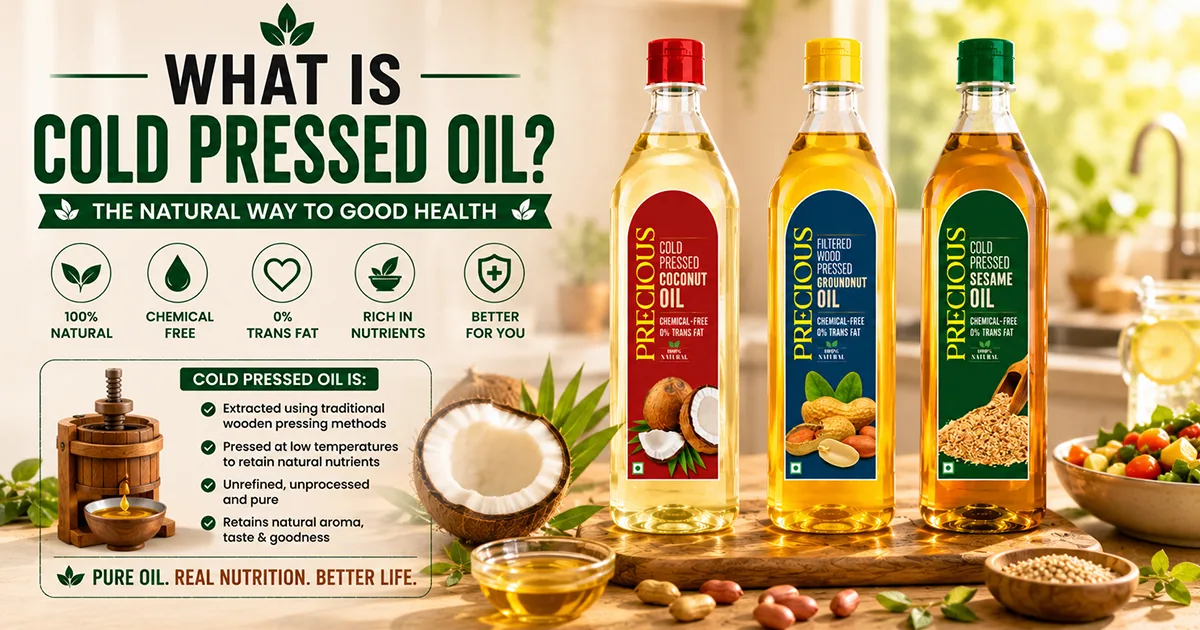
What Is Cold Pressed Oil? The Complete Guide for Indian Consumers
What is cold pressed oil? It is cooking oil made by crushing seeds at low temperature with no chemicals — the traditional Indian method that preserves 100% of the seed’s natural vitamins, antioxidants, and flavour.
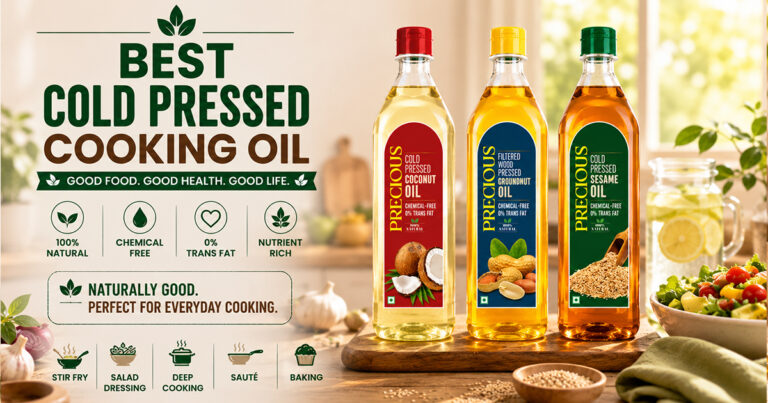
Quick Answer: Cold pressed oil is cooking oil made by mechanically crushing seeds at low temperatures (below 45°C), using no chemical solvents or external heat. This gentle process preserves 100% of the seed’s natural vitamins, antioxidants, and flavour compounds. Precious cold pressed oils — groundnut, sesame, and coconut — are made using the traditional Indian wood-press method (Mara Chekku), the purest form of cold pressing available.
You have seen “cold pressed” on labels in health food stores. You may have heard it mentioned by nutritionists or wellness influencers. But what does “cold pressed” actually mean? How is it different from regular cooking oil? And does the difference genuinely matter for your health?
This is the definitive, no-jargon guide to cold pressed oil — written specifically for Indian consumers who want to understand what they are putting in their bodies and on their families’ plates every day.
Contents
- 1 What Is Cold Pressed Oil? The Simple Definition
- 2 The History of Cold Pressed Oil in India
- 3 How Cold Pressed Oil Is Made: Step by Step
- 4 Cold Pressed Oil vs Refined Oil: The Nutritional Gap
- 5 Types of Cold Pressed Oil: A Complete Overview
- 6 Health Benefits of Cold Pressed Oil
- 7 How to Use Cold Pressed Oil in Your Kitchen
- 8 How to Store Cold Pressed Oil
- 9 How to Identify Genuine Cold Pressed Oil
- 10 Frequently Asked Questions
- 10.1 What is cold pressed oil in simple terms?
- 10.2 Is cold pressed oil good for health?
- 10.3 What is the difference between cold pressed and extra virgin oil?
- 10.4 Can cold pressed oil be used for cooking at high heat?
- 10.5 Is cold pressed oil better for cooking than refined oil?
- 10.6 Why is cold pressed oil more expensive?
- 10.7 Does cold pressed oil go bad quickly?
- 10.8 Which cold pressed oil is best for Indian cooking?
- 11 The Precious Promise: Cold Pressing as a Philosophy
- 12 What Is Cold Pressed Oil? Summary for Indian Consumers
What Is Cold Pressed Oil? The Simple Definition
Cold pressed oil is oil extracted from seeds, nuts, or fruits by applying mechanical pressure at low temperatures. “Cold” refers to the temperature at which the oil is extracted — no external heat is added, and the pressing process is slow enough that friction does not significantly raise the temperature either.
Think of it like this: if you squeezed a handful of peanuts very slowly and gently, some oil would drip out. That oil would smell exactly like fresh peanuts, have a rich golden colour, and contain everything beneficial that was inside the peanut. That is essentially what cold pressing does, at a larger scale.
The opposite of cold pressed is refined oil, which is extracted using chemical solvents (hexane, a petroleum-based chemical), then heated to very high temperatures (up to 260°C) for bleaching and deodorising. The result is an oil that looks clean and neutral but has had most of its nutritional value processed away.
The History of Cold Pressed Oil in India
Cold pressing is not a new idea. It is actually the ancient idea — the one that humans used for thousands of years before the industrial revolution invented chemical extraction.
In India, the cold-pressed oil tradition is called Mara Chekku (Tamil), Kachi Ghani (Hindi/Punjabi), or Ghani press. Every village in pre-industrial India had its own oil mill — the chekku kadai — where a wooden press turned by a bull would extract fresh oil from sesame, groundnuts, coconut, or mustard for the local community.
The oil produced would be used within days. It was fresh, aromatic, intensely flavourful, and packed with nutrients. People cooked with it, massaged their bodies with it, used it in religious ceremonies, and gave it as medicine.
Then, in the mid-20th century, industrial food processing arrived. Hexane-based extraction was 3x cheaper and extracted 40% more oil from the same seeds. The chekku kadai slowly disappeared. Refined, chemically extracted oil took over Indian kitchens.
Today, a growing number of Indian families are asking: what did we lose when we switched? The answer, as we will explain in this guide, is: quite a lot.
How Cold Pressed Oil Is Made: Step by Step
The Seed Selection Stage
Because cold pressing uses no chemicals and no bleaching, the quality of the source seed determines everything about the finished oil. There is nowhere to hide inferior raw materials — you cannot bleach away the flavour of a bad groundnut or deodorise away the odour of a stale sesame seed.
At Precious, this means sourcing only premium-grade groundnuts, sesame, and coconut from trusted farms in Tamil Nadu. Each batch is assessed before pressing. Quality seed = quality oil. It is that direct.
The Pressing Stage
The seeds are fed into a Mara Chekku — a wooden mortar and pestle apparatus. A hardwood shaft rotates inside a hardwood container, slowly crushing the seeds. Because:
- The rotation speed is low
- Both surfaces are wood (which absorbs friction heat rather than transmitting it)
- No external heat is applied
…the oil emerges at ambient temperature — typically 35–45°C. The technical definition of cold-pressed is below 49°C; Precious wood pressing achieves well under this threshold.
The crushed seeds (seed cake) separate from the oil and fall to the bottom of the mortar. The seed cake is then used as nutritious animal feed or compost — nothing is wasted.
The Filtration Stage
The raw oil — still containing fine particles of seed material — is poured into settling tanks. Natural gravity does the initial separation. The heavier particles sink. The lighter oil floats. Then the oil is strained through clean cotton cloth — a natural physical filter that removes particles without chemical treatment.
The result may have a very slight cloudiness or a tiny amount of natural sediment at the bottom. This is not a flaw — it is proof that the oil has not been chemically clarified. If you pour a bottle of Precious oil and notice a small amount of sediment, give it a gentle swirl and proceed. It is natural and harmless.
The Bottling Stage
The filtered oil goes directly into bottles. No preservatives are added. No antioxidants are added back synthetically. The oil’s natural Vitamin E, sesamol (in sesame), resveratrol (in groundnut), and polyphenols (in coconut) act as the natural preservation system.
This is why cold pressed oil has a shorter shelf life than refined oil — and why that shorter shelf life is actually a sign of authenticity, not a quality defect.
Cold Pressed Oil vs Refined Oil: The Nutritional Gap
Understanding what cold pressing preserves requires understanding what refining destroys. Here is the complete picture:
| Nutrient / Compound | In Cold Pressed Oil | In Refined Oil |
|---|---|---|
| Vitamin E (tocopherols) | Fully retained | 80–90% destroyed by heat |
| Antioxidant polyphenols | Fully retained | Removed during bleaching |
| Sesame lignans (sesamol) | Preserved | Destroyed by high heat |
| Phytosterols | Intact | Significantly reduced |
| Resveratrol (groundnut) | Present | Absent (heat-destroyed) |
| Natural flavour compounds | Intact — smells of the seed | Absent — deodorised away |
| Trans fats | Zero | Trace amounts formed in deodorising |
| Chemical residues | None | Trace hexane possible |
| Synthetic preservatives | None | TBHQ and others added |
Types of Cold Pressed Oil: A Complete Overview
Any oil-bearing seed can be cold pressed. Here are the most important for Indian cooking:
Cold Pressed Groundnut Oil (Peanut Oil)
The everyday cooking oil of South India. Cold pressed groundnut oil is a rich golden yellow with a powerful, authentic peanut aroma. High in MUFA (~46%), Vitamin E, and resveratrol. Versatile enough for any cooking purpose — frying, sautéing, tadka, even salad dressings. Precious Wood-Pressed Groundnut Oil is made using the traditional Tamil Nadu Mara Chekku process.
Cold Pressed Sesame Oil (Gingelly Oil)
Deep amber, intensely aromatic, and uniquely nutritious because of its sesame lignans (sesamol, sesamin). The most studied Indian cooking oil for cardiovascular benefits. Essential for authentic South Indian cooking, Ayurvedic practice, and traditional pickles. Precious Cold Pressed Sesame Oil retains 100% of its natural lignan content.
Cold Pressed Coconut Oil
White solid at room temperature, clear liquid when warm. Rich in lauric acid (MCT), polyphenols, and Vitamin E. The backbone of Kerala and coastal Indian cooking, and a beloved ingredient in Ayurvedic medicine and natural beauty care. Precious Cold Pressed Coconut Oil solidifies below 24°C — a sign of purity and proper extraction.
Other Cold Pressed Oils (not in the Precious range)
Cold pressed mustard oil (the traditional North Indian oil), cold pressed sunflower oil, cold pressed flaxseed oil (very high Omega-3, used raw), cold pressed olive oil (the Mediterranean staple), and cold pressed almond oil (primarily a beauty/skincare product in the Indian market).
Health Benefits of Cold Pressed Oil
The health benefits of cold pressed oil flow directly from the preservation of natural compounds that refining destroys. Here is a systematic look:
1. Heart Health
The monounsaturated and polyunsaturated fats in cold pressed oils — fully preserved because no high-heat processing alters them — actively lower LDL (bad) cholesterol while maintaining or raising HDL (good) cholesterol. The antioxidants (Vitamin E, sesamol) prevent LDL oxidation, which is the process that triggers arterial plaque formation. Phytosterols block dietary cholesterol from being absorbed. Sesame oil specifically has clinical evidence for modest blood pressure reduction.
2. Anti-Inflammatory Effects
Chronic inflammation is increasingly recognised as a root cause of heart disease, diabetes, and age-related cognitive decline. The natural polyphenols and tocopherols in cold pressed oil directly counter inflammatory signalling pathways in the body. Refined oils, which lack these compounds, offer no anti-inflammatory protection and may even contribute to inflammation through oxidised fats from processing.
3. Immune Support
Vitamin E — fully retained in cold pressed oils, largely destroyed in refined oils — plays a key role in immune function. It is required for the normal activity of T-cells, supports the integrity of mucous membranes (your body’s first line of defence), and acts as an antioxidant that protects immune cells from oxidative damage.
4. Skin and Hair Nourishment
The Vitamin E, natural fatty acids, and antioxidants in cold pressed oils are directly nourishing to skin and hair when applied topically. Precious Sesame Oil has been used in Ayurvedic medicine for thousands of years as a body oil, scalp treatment, and skin conditioner. Precious Coconut Oil penetrates the hair shaft uniquely well, reducing protein loss and preventing damage.
5. Better Digestion
Natural cold pressed oils contain lecithin — a fat emulsifier found in the seed that is destroyed during refining. Lecithin supports fat digestion and is part of why traditional foods cooked in Mara Chekku oil were considered easier on the stomach than modern refined alternatives.
6. Richer Flavour = Better Cooking
This is a health benefit too. When food tastes genuinely good, we are more likely to cook at home, more likely to eat vegetables (made delicious with a proper sesame tadka or groundnut oil-based curry), and less likely to reach for processed snacks. Good oil is good food. And good food is the foundation of good health.
How to Use Cold Pressed Oil in Your Kitchen
The Smoke Point Question
The most common concern about cold pressed oils is smoke point. Here is the straight answer: Precious Wood-Pressed Groundnut Oil has a smoke point of approximately 160°C. Standard Indian cooking — tadka, frying, curries — happens at 140–175°C. These ranges are compatible.
The key is not to overheat the oil. If your Precious Groundnut Oil starts to smoke, it is telling you your flame is too high. Reduce the heat. This is a useful signal — refined oils engineered to withstand 230°C give you no such warning when they are silently degrading at 180°C.
Which Precious Oil for What
- Everyday curries and sabzis: Precious Groundnut Oil
- South Indian tadka and tempering: Precious Sesame Oil
- Deep frying: Precious Groundnut Oil
- South Indian regional dishes (Avial, Thoran): Precious Coconut Oil
- Baking: Precious Coconut Oil
- Raw drizzle on salads or finished dishes: Precious Sesame or Groundnut Oil
- Pickles: Precious Sesame Oil (acts as a natural preservative)
- Massage oil: Precious Sesame Oil (traditional Ayurvedic)
- Baby massage: Precious Coconut Oil
How Much to Use
Two to three tablespoons per person per day is a reasonable target for an adult cooking three meals. The strong flavour of authentic cold pressed oils naturally encourages slightly lower usage — you reach flavour satisfaction faster than with a neutral refined oil.
How to Store Cold Pressed Oil
- Location: Store in a cool, dark cupboard away from sunlight and heat. The pantry or a kitchen cabinet away from the stove is ideal.
- Seal: Always replace the cap firmly after pouring. Oxygen is the enemy of freshness.
- Shelf life: Use within 6–9 months of opening for best quality. Sesame oil can last up to 12 months due to its exceptional natural antioxidant content.
- Coconut oil in cold weather: If Precious Coconut Oil solidifies in winter (which it does below ~24°C — this is completely normal), place the bottle in a bowl of warm water to liquefy. Do not microwave.
How to Identify Genuine Cold Pressed Oil
The term “cold pressed” is not tightly regulated in India. Some expeller-pressed oils that reach 80–120°C during pressing are marketed as cold pressed. Here is how to verify authenticity:
- Smell test: Genuine cold pressed oil smells strongly of its source seed. Groundnut oil should smell unmistakably of fresh peanuts. Sesame should have a rich earthy aroma. Coconut should smell sweet and tropical. No smell = refined or adulterated.
- Colour test: Cold pressed oils retain their natural colour from the seed. Groundnut oil is deep golden. Sesame oil is amber. Colourless or very pale versions have been bleached.
- Sediment test: A tiny amount of natural cloudiness or settling at the bottom is a positive sign — proof of cloth filtration rather than chemical treatment.
- Price test: Genuine cold pressed oil costs more — because it takes 2–3x more seed per litre. If the price matches refined oil, question the method.
- Label test: Look for “Mara Chekku”, “Kachi Ghani”, or “wood-pressed” specifically. Ingredient list should contain only the seed name.
Frequently Asked Questions
What is cold pressed oil in simple terms?
Cold pressed oil is cooking oil made by squeezing seeds slowly at low temperatures with no chemicals. The oil that comes out is the pure, unprocessed juice of the seed — with its full vitamins, antioxidants, and flavour intact. It is the opposite of refined oil, which uses chemical solvents and very high heat.
Is cold pressed oil good for health?
Yes, genuinely so. Cold pressed oils retain Vitamin E, antioxidants, phytosterols, and natural fatty acids that support heart health, reduce inflammation, boost immunity, and provide real nutrition. Refined oils, which lack these compounds, provide fat and calories but minimal nutritional benefit.
What is the difference between cold pressed and extra virgin oil?
“Extra virgin” is a grading term most commonly used for olive oil. Extra virgin olive oil is cold pressed (first press, no heat). So extra virgin olive oil is a specific type of cold pressed oil. In the Indian context, the equivalent term would be “Mara Chekku” or “Kachi Ghani” — indicating the first mechanical press at low temperature with no chemicals.
Can cold pressed oil be used for cooking at high heat?
Precious Wood-Pressed Groundnut Oil is suitable for all standard Indian cooking including frying, with a smoke point of ~160°C adequate for tempering, stir-frying, and deep frying. Cook at medium heat to preserve maximum nutritional value and to stay below the smoke point.
Is cold pressed oil better for cooking than refined oil?
For nutritional quality, yes — significantly. Cold pressed oils retain vitamins, antioxidants, and natural protective compounds that refined oils lack. For pure smoke point considerations, refined oils can handle higher heat technically — but for the temperatures at which most Indian cooking actually happens (below 180°C), the practical difference is minimal, while the nutritional difference is enormous.
Why is cold pressed oil more expensive?
Cold pressing extracts only 50–60% of the available oil from seeds. Chemical extraction gets 99%. So you need 2–3 times more seeds per litre of cold pressed oil. Add the slower production rate and higher quality seed requirements, and the higher price is directly explained. You are paying for the actual cost of doing it properly.
Does cold pressed oil go bad quickly?
Cold pressed oils have shorter shelf lives than refined oils (6–12 months vs 18–24 months) because they contain no synthetic preservatives. But their natural antioxidants (Vitamin E, sesamol) provide meaningful natural protection. Stored correctly (cool, dark, sealed), Precious oils maintain excellent quality throughout their shelf life.
Which cold pressed oil is best for Indian cooking?
Precious Wood-Pressed Groundnut Oil is the most versatile for everyday Indian cooking. Precious Sesame Oil is essential for South Indian dishes and has the strongest heart health research. Precious Coconut Oil is irreplaceable for Kerala-style cooking and has unique properties as both a cooking oil and a wellness ingredient.
The Precious Promise: Cold Pressing as a Philosophy
At Precious, cold pressing is not a production method chosen for marketing purposes. It is a conviction about food. Our co-founders believe that the best cooking oil is the one closest to nature — the one that leaves everything the seed contains inside the bottle.
Our Tamil Nadu Mara Chekku operation presses every batch at below 45°C. We never add chemicals, preservatives, or synthetic antioxidants. We filter through cotton cloth. We bottle fresh. And we let our customers decide — with their nose, their palate, and their kitchen results — whether the difference is worth it.
Every person who opens a bottle of Precious Groundnut Oil for the first time and says “oh — it actually smells like peanuts” is discovering what cold pressing does. The smell is the nutrition. The aroma is the antioxidants. The colour is the Vitamin E. When you can smell and see and taste the difference, you are experiencing it directly — no laboratory required.
Discover what real cold pressed oil tastes like. Shop Precious at shop Precious cold pressed oils
What Is Cold Pressed Oil? Summary for Indian Consumers
What is cold pressed oil? It is the simplest and most nutritionally complete form of cooking oil available — the direct mechanical extract of a seed at below 45°C, with no chemicals, no bleaching, and no heat treatment. Understanding what cold pressed oil is helps you make better choices at every shopping trip: if the oil has no smell, it is refined; if it smells of the seed, it is genuine. What is cold pressed oil in practice? It is Precious Groundnut Oil that smells like peanuts, Precious Sesame Oil that smells earthy and nutty, and Precious Coconut Oil that smells of fresh coconut.
The answer to what is cold pressed oil is also an answer to what was always in Indian kitchens before industrial food processing arrived: the pure, unaltered liquid from a crushed seed.
Now that you understand the process, explore what it means for your health: read our honest breakdown of cold pressed vs refined oil, discover the full health benefits of cold pressed oils, and find the best cold pressed oils in India for everyday cooking.
India has a centuries-old tradition of cold pressing oils through the marachekku method — a wooden mortar that extracts oil at room temperature with zero heat. Read our story of marachekku oil from Coimbatore to see how this ancient technique produces genuinely unrefined oil.
Further reading: FSSAI Edible Oils Regulations — India’s regulatory framework for cooking oils. NIN India — National Institute of Nutrition food composition data for Indian oils.
Disclaimer: This article is for educational purposes only and does not constitute medical advice. All Precious products are FSSAI compliant. For specific dietary guidance, consult a qualified nutritionist or healthcare professional.
Try These Recipes with Precious Cold Pressed Oil

Written by
Suren is the co-founder of KN Agro Concepts and the creator of Precious cold-pressed oils. Based in Tamil Nadu, he has spent years working directly with traditional Mara Chekku wood-press artisans to bring authentic, chemical-free oils from Coimbatore to health-conscious families across India. He writes about cold-pressed oil, traditional Indian food practices, and the science of natural nutrition.
Follow on Facebook →


3 Comments