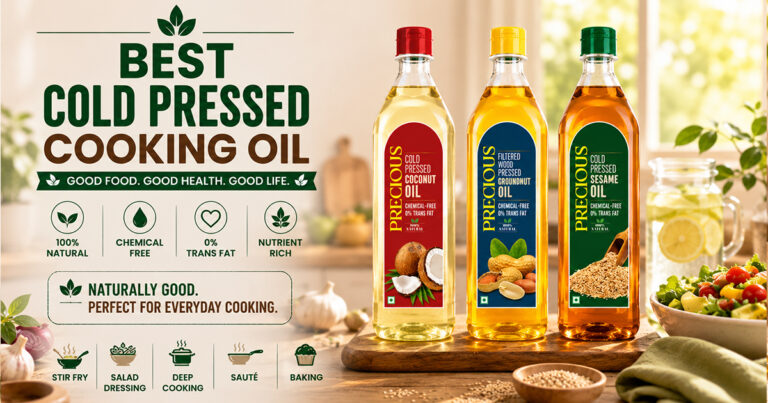
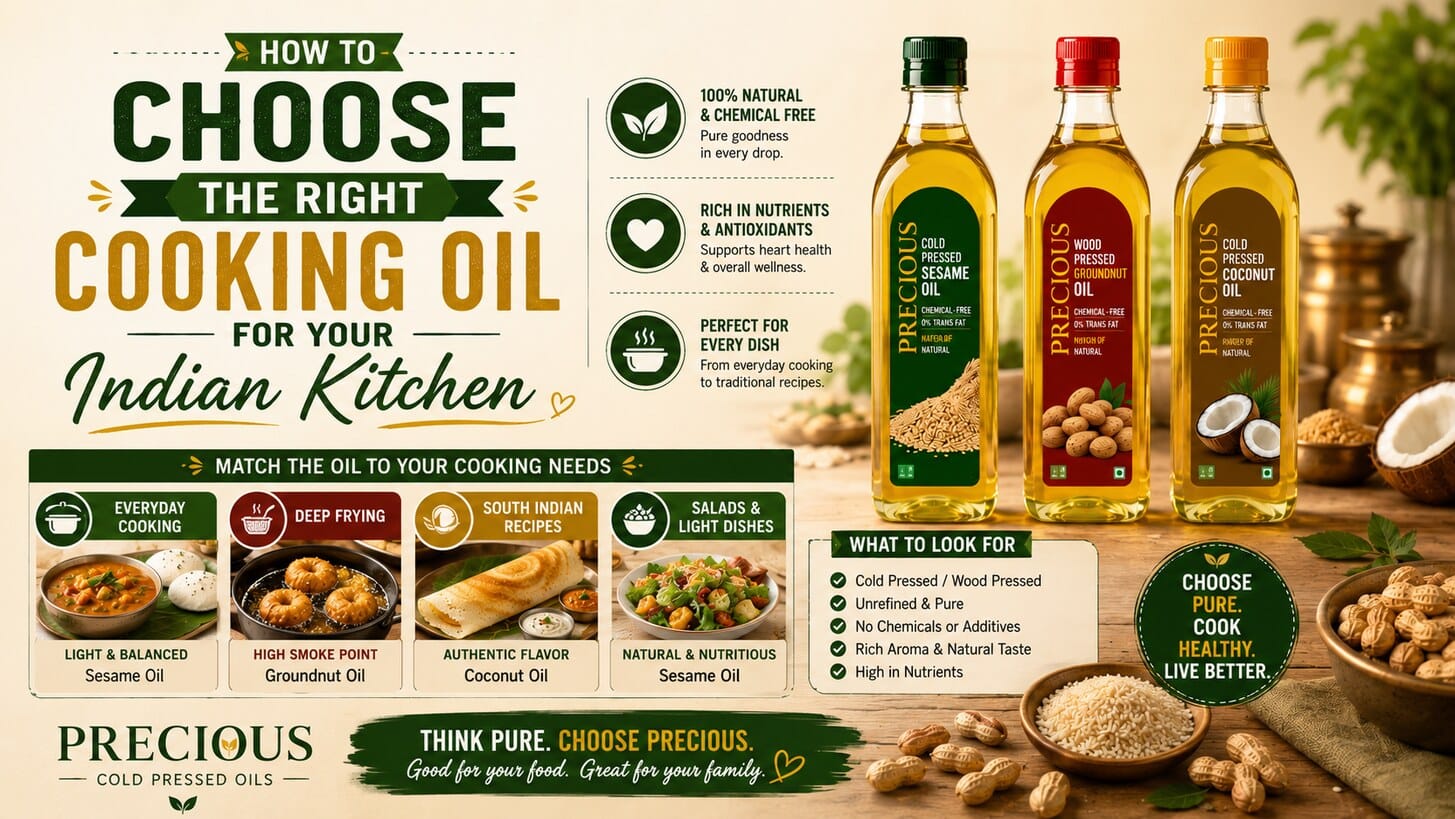
How to Choose the Right Cooking Oil for Your Indian Kitchen
The average Indian kitchen uses one or two oils for everything — a habit inherited from the refined oil marketing of the 80s and 90s. Traditional Indian cooking used multiple oils, each chosen deliberately for a specific dish, cuisine, or technique. This guide helps you rebuild that knowledge.
Contents
- 1 The Problem with Using One Oil for Everything
- 2 Three Parameters to Evaluate Any Cooking Oil
- 3 Which Oil for Which Indian Dish
- 4 How Much Oil to Use Each Day
- 5 The Rotation Model for Indian Kitchens
- 6 Red Flags When Buying Cold Pressed Oil
- 7 The Marachekku Difference
- 8 Start Cooking: Recipes for Every Oil
The Problem with Using One Oil for Everything
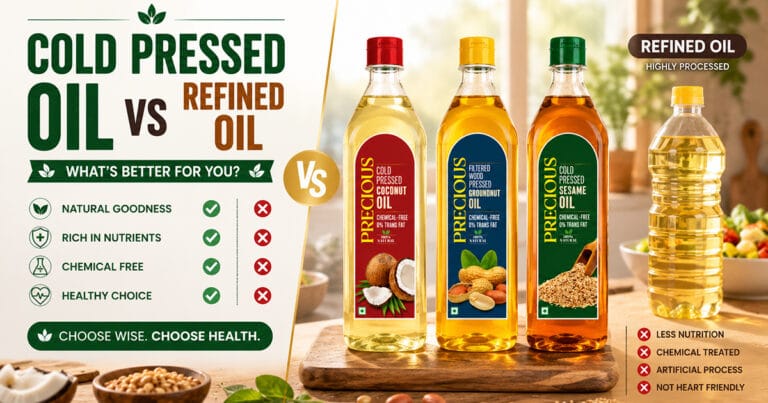
Refined oils are designed to be neutral — no aroma, no flavour, high smoke point, long shelf life. They achieve this through chemical processing, bleaching, and deodorising. The neutrality that makes them convenient is exactly what makes them nutritionally empty. When you cook dal in refined sunflower oil versus cold pressed groundnut oil, you’re not just changing fat composition — you’re fundamentally changing the dish.
Three Parameters to Evaluate Any Cooking Oil
1. Smoke Point
The temperature at which oil begins to break down and release harmful compounds. Relevant primarily for deep frying and high-heat searing:
- Cold pressed groundnut oil: ~160°C — suitable for Indian deep frying at medium flame
- Cold pressed sesame oil: ~175°C (but best used for tempering and finishing, not high-heat frying)
- Cold pressed coconut oil: ~177°C (refined coconut oil reaches 204°C)
- Refined sunflower oil: ~227°C
For most Indian home cooking at medium flame, the smoke point of cold pressed groundnut oil is more than adequate.
2. Fat Composition
Not all fats are equal:
- Monounsaturated fats (MUFA): Heart-healthy. Stable at cooking temperatures. Found abundantly in groundnut and sesame oil.
- Polyunsaturated fats (PUFA): Less stable at heat. The Omega-6 to Omega-3 ratio matters — most Indians already overconsume Omega-6 relative to Omega-3.
- Saturated fats: Stable at heat, but dietary guidelines recommend limiting them. Coconut oil is ~92% saturated fat — use in moderation.
- Trans fats: Avoid entirely. Found in vanaspati and partially hydrogenated vegetable oils.
3. Processing Method
This is the parameter most consumers overlook:
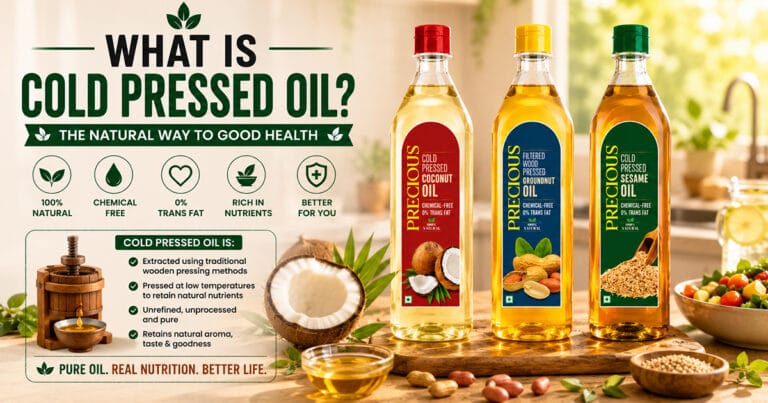
- Wooden press / Marachekku / Kachi Ghani: Stays below 45°C. Maximum nutrition preserved. Authentic traditional method.
- Cold pressed (metal expeller): Claims “cold pressed” but reaches 45–70°C from friction. Some nutritional loss.
- Hot pressed expeller: 70–120°C. Significant nutritional loss.
- Solvent extracted (refined): Hexane extraction + 180–220°C processing. Most commercially available oil. Negligible nutritional value.
Which Oil for Which Indian Dish
Everyday Dal and Sabzi
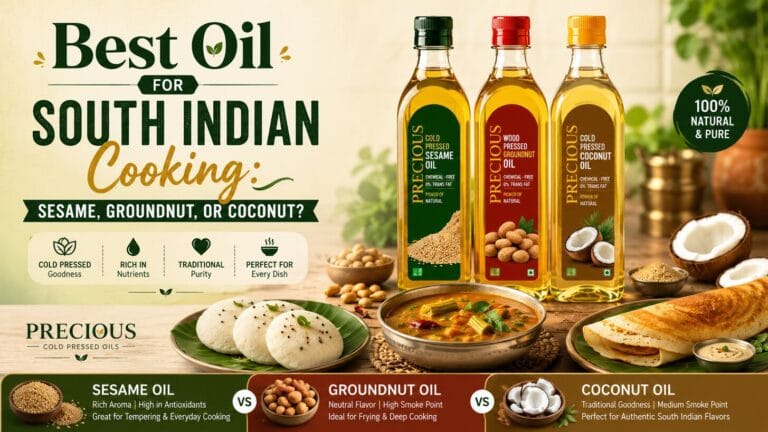
Cold pressed groundnut oil is your default. Its 46% MUFA content, natural Vitamin E, and clean peanut flavour make it ideal for the backbone of the Indian daily meal. For distinctly South Indian dishes, sesame oil tadka transforms the flavour profile.
Deep Frying (Puri, Pakoda, Murukku, Bajji)
Cold pressed groundnut oil only. It has the highest smoke point among cold pressed oils and holds up well through 2–3 frying sessions before degrading. Keep flame at medium.
South Indian Tempering (Tadka)
Cold pressed sesame oil is the traditional and correct choice for South Indian tempering — mustard seeds, curry leaves, dried red chillies, and asafoetida in sesame oil create the flavour base for rasam, sambar, kootu, and poriyal. The sesamol in cold pressed sesame oil is a powerful antioxidant that survives brief high-heat exposure.
North Indian Curries and Gravies
Cold pressed groundnut oil for the main cooking; a finish of cold pressed mustard oil is authentic for Punjabi and UP cooking (though mustard oil has a strong flavour that doesn’t suit all palates).
Baking and Sweets
Cold pressed coconut oil is the most appropriate cold pressed oil for baking, as its flavour profile is the closest to butter for Indian sweet applications. Halwa, laddoo, and coconut-based sweets all work well with cold pressed coconut oil.
Kerala and Coastal Tamil Nadu Cooking
Cold pressed coconut oil is not optional — it’s the defining flavour of this cuisine. Avial, Thoran, Olan, Fish Curry, and Stew taste categorically different without coconut oil. The MCTs in coconut oil are metabolised differently from long-chain fats and have been associated with improved cognitive function in some research.
How Much Oil to Use Each Day
Even a good oil adds a lot of calories, so the amount matters as much as the type. The ICMR–National Institute of Nutrition dietary guidelines advise keeping visible oil moderate and using a combination of oils rather than one. In practice: measure with a spoon instead of pouring from the bottle, save deep frying for occasions, and never reuse frying oil again and again. If you have a medical condition, ask your doctor or a dietitian how much fat suits you.
The Rotation Model for Indian Kitchens
Rather than picking one oil, use a rotation:
- Primary cooking oil: Cold pressed groundnut oil (75% of cooking)
- South Indian tempering: Cold pressed sesame oil (for all traditional Tamil/Telugu tadka)
- Kerala / Coastal dishes: Cold pressed coconut oil
- Salad and cold use: Cold pressed groundnut oil or cold pressed olive oil
All three Precious cold pressed oils are available in a combo pack, making it easy to maintain this rotation without multiple deliveries.
Red Flags When Buying Cold Pressed Oil
- No strong seed aroma when you open the bottle
- Priced the same as refined oil of the same volume
- No information about extraction temperature or method
- Claims “cold pressed” but packed in a facility that also processes refined oils at scale
- No FSSAI certification number on label
The Marachekku Difference
All Precious oils use the traditional Marachekku wooden press in Coimbatore, Tamil Nadu — the region with the deepest tradition of chekku ennai production. The wooden press absorbs heat that metal presses generate from friction, keeping extraction temperature at or below 45°C even without active cooling.
The result is oil that smells, tastes, and nourishes the way oil should — the way your grandparents’ kitchen used to smell on frying days.
Shop all three Precious cold pressed oils with pan-India delivery.
Shop Precious Cold Pressed Oils → According to FSSAI guidelines, edible oils should be stored correctly and used within their shelf life.Start Cooking: Recipes for Every Oil
- Kara Kulambu — sesame oil
- South Indian Mutton Curry — groundnut oil
- Vegetable Kurma — coconut oil
- Dal Makhani — groundnut oil
- Healthy Custard Fruit Mix — coconut oil

Written by
Suren is the co-founder of KN Agro Concepts and the creator of Precious cold-pressed oils. Based in Tamil Nadu, he has spent years working directly with traditional Mara Chekku wood-press artisans to bring authentic, chemical-free oils from Coimbatore to health-conscious families across India. He writes about cold-pressed oil, traditional Indian food practices, and the science of natural nutrition.
Follow on Facebook →