Cold Pressed Groundnut Oil: Benefits, Uses and Why It Beats Refined Oil
Cold pressed groundnut oil is India’s most underrated cooking oil. Used for centuries across Tamil Nadu, Andhra Pradesh, and Gujarat, it was systematically replaced by refined refined vegetable oil during the 1980s and 90s — largely driven by marketing budgets, not nutritional science. Here’s what the science actually says, and why switching back matters.
Contents
- 1 What Is Cold Pressed Groundnut Oil?
- 2 Nutritional Profile of Cold Pressed Groundnut Oil
- 3 Proven Cold Pressed Groundnut Oil Benefits for Health
- 4 Cold Pressed Groundnut Oil vs Refined Groundnut Oil: Key Differences
- 5 How to Use Cold Pressed Groundnut Oil in Your Kitchen
- 6 How to Identify Pure Cold Pressed Groundnut Oil
- 7 Try Cooking with Precious Groundnut Oil
What Is Cold Pressed Groundnut Oil?
Cold pressed groundnut oil (also called cold pressed peanut oil or kachi ghani moongphali tel) is extracted by crushing raw peanuts in a wooden or stone press without applying external heat. The oil temperature stays below 45°C throughout extraction, preserving its natural compounds.
This is fundamentally different from the refined groundnut oil available in most supermarkets, which is solvent-extracted (using hexane), deodorised, bleached, and heated to 200°C+ during refining. By the time it reaches the bottle, most of its natural nutrition has been destroyed.
Nutritional Profile of Cold Pressed Groundnut Oil
- Monounsaturated fats (MUFA): ~46% — the same heart-healthy oleic acid that makes olive oil famous
- Polyunsaturated fats (PUFA): ~32% — including linoleic acid (Omega-6)
- Saturated fats: ~17% — significantly lower than coconut oil
- Vitamin E: Natural alpha-tocopherol, a fat-soluble antioxidant (lost in refining)
- Resveratrol: A polyphenol with documented anti-inflammatory and cardiovascular benefits (lost above 70°C)
- Phytosterols: Plant sterols that compete with dietary cholesterol for absorption
Proven Cold Pressed Groundnut Oil Benefits for Health
1. Cardiovascular Support
The high MUFA content of cold pressed groundnut oil helps maintain healthy LDL-to-HDL ratios when used in place of saturated or trans fats. The natural resveratrol — which is structurally identical to the compound found in red grapes — has been shown in multiple studies to support endothelial function and reduce oxidative stress on blood vessels.
2. Stable for Indian Cooking
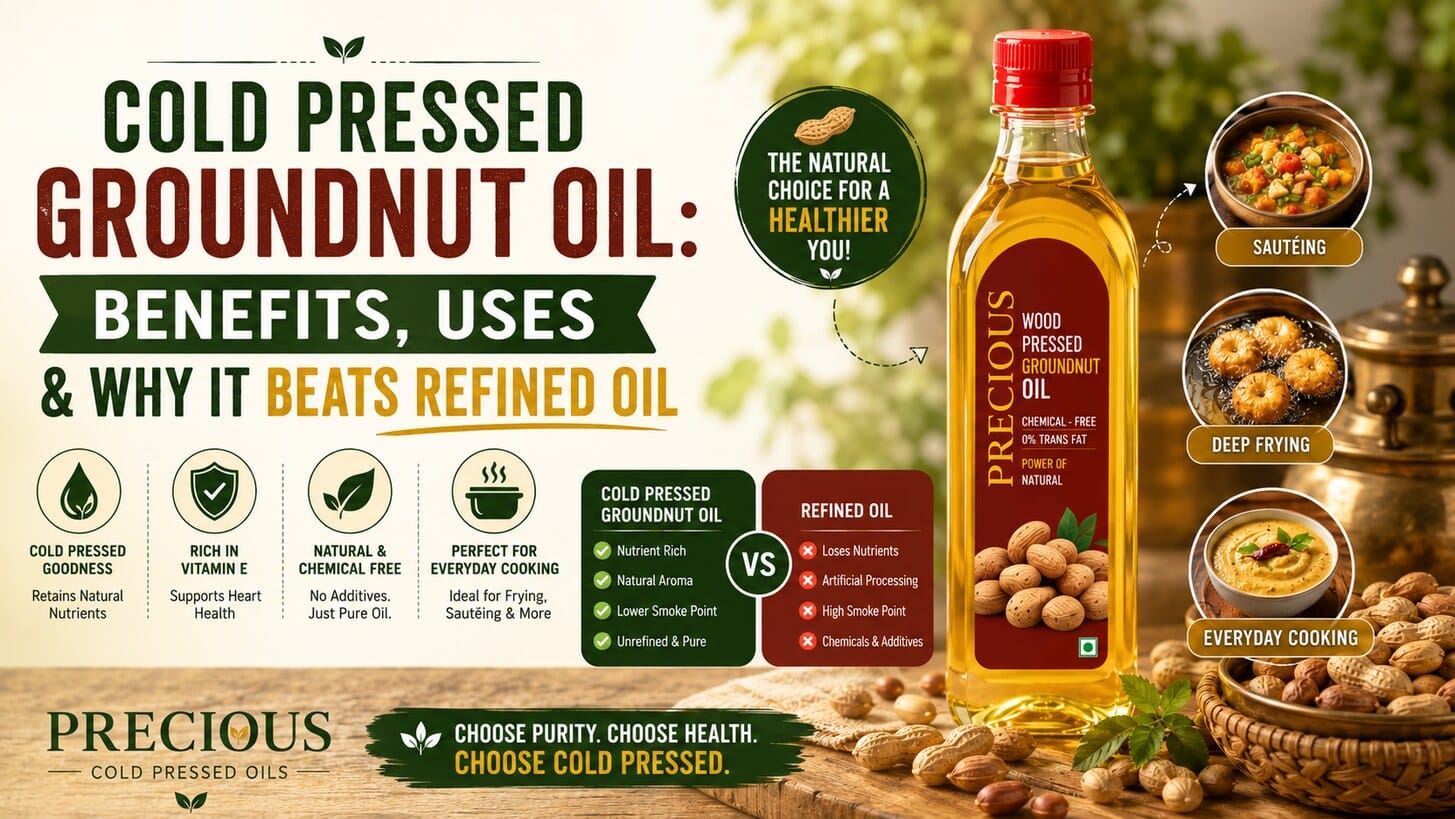
With a smoke point of ~160°C, cold pressed groundnut oil is the most suitable of the cold pressed oils for deep frying and high-heat Indian cooking. Refined oils have higher smoke points (200°C+) but lose all nutritional value through the refining process itself.
3. Natural Vitamin E
Vitamin E in natural food form is far more bioavailable than synthetic supplements. A tablespoon of cold pressed groundnut oil provides a meaningful dose of alpha-tocopherol without the supplement industry markup.
4. Blood Sugar Regulation
The high MUFA content has been associated with improved insulin sensitivity in multiple studies, making cold pressed groundnut oil a thoughtful choice for diabetic and pre-diabetic households.
Cold Pressed Groundnut Oil vs Refined Groundnut Oil: Key Differences
| Factor | Cold Pressed | Refined |
|---|---|---|
| Extraction temp | <45°C | 180–220°C |
| Vitamin E | Preserved | Largely destroyed |
| Resveratrol | Present | Absent |
| Aroma | Strong peanut aroma | Neutral/odourless |
| Hexane residue | None | Possible traces |
| Price per use | Higher per litre, similar per meal (less needed) | Lower per litre |
How to Use Cold Pressed Groundnut Oil in Your Kitchen
Daily Cooking (Best Use)
Use cold pressed groundnut oil for all your regular Indian cooking: dal tadka, sabzi, curries, and stir-fries. Keep the flame at medium. The peanut aroma enhances savory dishes without overpowering delicate spices.
Deep Frying
Cold pressed groundnut oil is the cold pressed oil of choice for deep frying — puri, bhaji, pakoda, murukku. Keep oil temperature between 140–160°C. Avoid overheating.
Salad Dressing
Use raw cold pressed groundnut oil as a base for South Indian-style salad dressings with mustard seeds and curry leaves.
Skin and Hair Care
Cold pressed groundnut oil is used in traditional Ayurvedic practice for abhyanga (oil massage) and as a carrier oil. Its Vitamin E content supports skin health when applied topically.
How to Identify Pure Cold Pressed Groundnut Oil
The smell test is your most reliable tool. Genuine cold pressed groundnut oil smells powerfully of fresh peanuts — not a faint hint, but the same aroma you get when you hold a handful of raw groundnuts under your nose. If there’s no strong smell, the oil has been processed regardless of what the label says.
Look for: cloudy appearance (fine particles settle — normal), golden-amber colour, FSSAI certification, and clear information about the extraction process (wooden/marachekku/kachi ghani).
Experience authentic Marachekku groundnut oil — made the traditional way.
Shop Precious Cold Pressed Groundnut Oil → National Institute of Nutrition data confirms groundnut oil’s high Vitamin E and MUFA content.
Try Cooking with Precious Groundnut Oil

Written by
Suren is the co-founder of KN Agro Concepts and the creator of Precious cold-pressed oils. Based in Tamil Nadu, he has spent years working directly with traditional Mara Chekku wood-press artisans to bring authentic, chemical-free oils from Coimbatore to health-conscious families across India. He writes about cold-pressed oil, traditional Indian food practices, and the science of natural nutrition.
Follow on Facebook →