
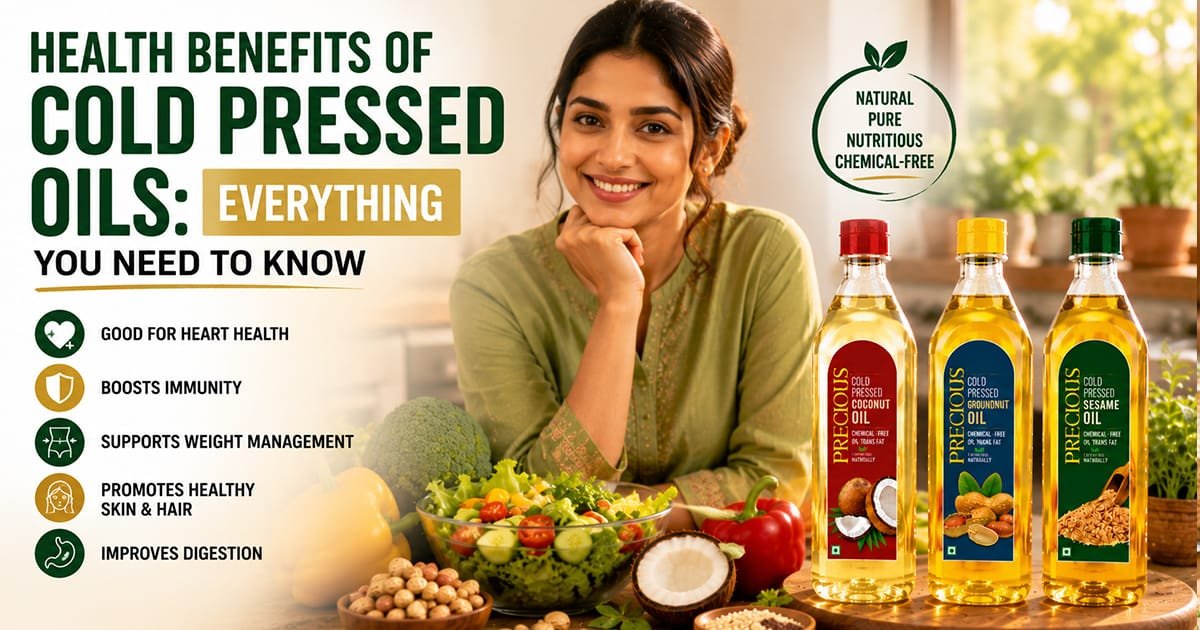
Health Benefits of Cold Pressed Oils: Everything You Need to Know
Understanding cold pressed oil health benefits is changing the way Indian kitchens cook. Cold pressed oils are having a well-deserved revival — and it is backed by science, not just nostalgia. Every morning, millions of households across India reach for a bottle of cooking oil without a second thought. But what if the oil you cook with every day is quietly stripping the nutrition out of every meal you prepare?
The health benefits of cold pressed oils — specifically wood pressed coconut oil, cold pressed groundnut oil, and cold pressed sesame oil — go far beyond what most people realise. In this comprehensive guide, we break down the science, the tradition, and the practical kitchen wisdom behind switching to cold pressed oils.
Whether you are new to the world of unrefined cooking oils or already using them and want to understand the full picture, this is everything you need to know about why cold pressed oils are the healthier choice — for your heart, your skin, your hair, and every meal on your table.
Contents
- 1 What Are Cold Pressed Oils and How Are They Made?
- 2 Cold Pressed vs Refined Oil: What Really Happens During Processing
- 3 Cold Pressed Oil Health Benefits: Coconut Oil
- 4 Cold Pressed Oil Health Benefits: Groundnut Oil
- 5 Cold Pressed Oil Health Benefits: Sesame Oil
- 6 Cold Pressed Oil Health Benefits for Your Heart: The Evidence
- 7 Cold Pressed Oils for Skin and Hair Care
- 8 Cooking with Cold Pressed Oils: A Practical Guide for Indian Kitchens
- 9 How to Choose the Right Cold Pressed Oil for Your Kitchen
- 10 What to Look for When Buying Cold Pressed Oils
- 11 Frequently Asked Questions About Cold Pressed Oils
- 11.1 Is cold pressed oil better than refined oil?
- 11.2 Can I use cold pressed oil for deep frying?
- 11.3 Why does cold pressed oil smell so much stronger than refined oil?
- 11.4 What is the difference between kachi ghani oil and cold pressed oil?
- 11.5 How is cold pressed sesame oil different from toasted sesame oil?
- 11.6 Do cold pressed oils expire faster than refined oils?
- 11.7 Are cold pressed oils safe for baby massage?
- 12 Conclusion: The Case for Switching to Cold Pressed Oils
What Are Cold Pressed Oils and How Are They Made?
Before diving into the health benefits, it is worth understanding exactly what “cold pressed” means — because the term gets used loosely, and not always accurately.
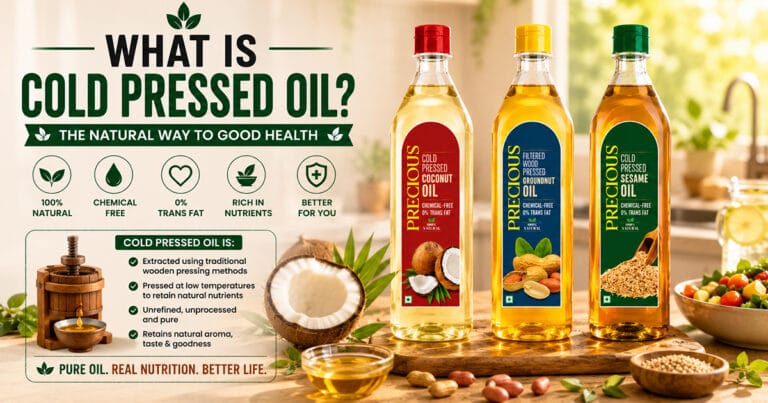
Cold pressing is a method of extracting oil from seeds and nuts without applying external heat. The seeds — groundnuts, sesame seeds, or coconut kernels — are fed into a wooden or metal press called a chekku or ghani in South Asia. The mechanical pressure of a rotating wooden cylinder crushes the seeds and forces the oil out naturally.
The critical difference? No heat is added. No solvents like hexane are used. No chemical treatments are applied at any stage.
In a traditional marachekku (wood cold press), the process is almost meditative — the large wooden beam rotates slowly, seeds are fed in gradually, and the oil drips out at temperatures that rarely exceed 40–49°C. This is cold pressing in its most authentic form, and it is the exact method used to produce every bottle of Precious cold pressed oil.
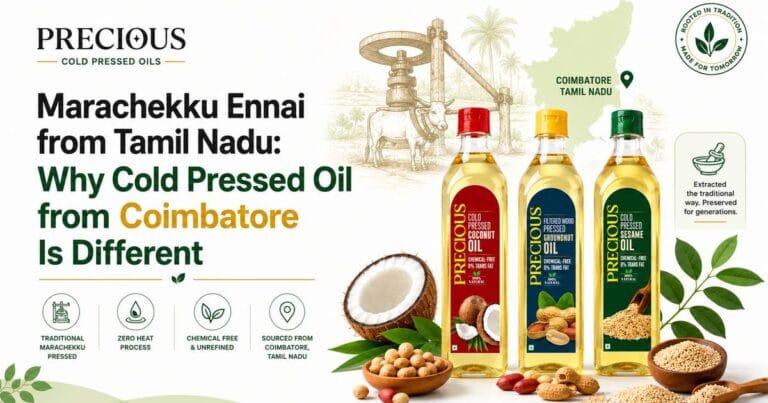
This is the process that has been used in Tamil Nadu and across South India for centuries. Before industrialisation, every village had its own oil mill. Farmers brought their sesame, groundnuts, and coconuts directly to the local chekku, and families used that oil for cooking, for their skin, for their hair, and as part of daily life.
Modern refining changed all of that. Understanding how — and what was lost — is the foundation for understanding why cold pressed oils are genuinely worth the switch.
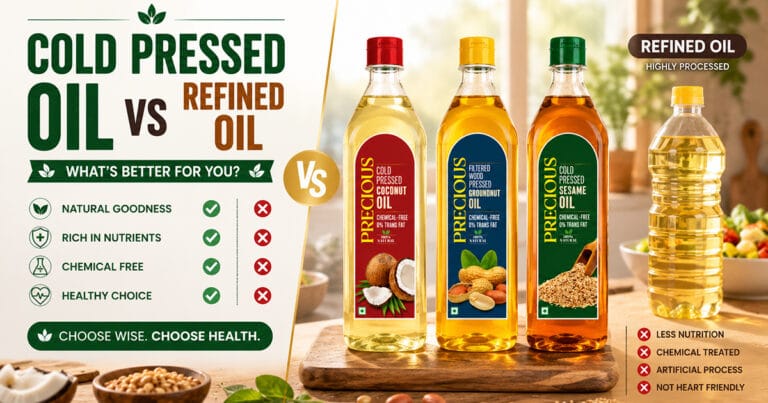
Cold Pressed vs Refined Oil: What Really Happens During Processing
Most commercially available cooking oils in India today — sunflower, palm, refined groundnut, and similar mass-market options — go through a multi-stage industrial process that transforms the raw oil beyond recognition. Understanding this process is key to understanding the difference between wood pressed oil and refined oil in terms of nutrition and health impact.
How Refined Oils Are Made
Step 1 — Solvent extraction: Seeds are bathed in hexane, a petroleum-derived solvent, which dissolves the oil out of the seeds. This method extracts a higher yield at lower cost — but hexane residues can remain in the final product, and the process destroys heat-sensitive nutrients.
Step 2 — Degumming: The crude oil is treated with water or phosphoric acid to remove phospholipids, including beneficial compounds like lecithin and other naturally occurring nutrients.
Step 3 — Neutralisation: Alkali chemicals such as sodium hydroxide are added to remove free fatty acids — stripping out more naturally occurring compounds in the process.
Step 4 — Bleaching: Activated clay or carbon removes colour pigments from the oil, including beta-carotene and chlorophyll — both of which carry genuine health value.
Step 5 — Deodorisation: The oil is heated to 200–270°C under vacuum to strip away all flavour and aroma. This high-heat step creates trans fatty acids as a byproduct and destroys the majority of remaining vitamins and antioxidants.
The end result is a clear, odourless, flavourless oil with most of its natural nutrition removed. You are essentially cooking with a blank caloric fat — edible, certainly, but stripped of what made the original seed nutritious in the first place.
What Cold Pressing Preserves
Cold pressed oils skip all of these steps. The oil is extracted mechanically, filtered, and bottled. Nothing added, nothing removed.
The result is an oil that retains its complete natural nutrition:
- Natural antioxidants — Vitamin E, polyphenols, sesamol, sesamin, and lignans
- Natural fatty acid profile — MUFA, PUFA, and saturated fats in their original, unaltered ratio as found in the seed
- Natural flavour and aroma — which is why cold pressed sesame oil smells unmistakably like sesame, and cold pressed groundnut oil carries the warm, earthy aroma of fresh groundnuts
- Natural colour — golden for groundnut, amber for sesame, clear-white for coconut
- Zero trans fats formed during industrial processing
This is the foundation of all the cold pressed oil health benefits discussed in detail below: you are getting the oil exactly as nature made it — complete, honest, and nutritionally intact.
Cold Pressed Oil Health Benefits: Coconut Oil
Cold pressed coconut oil is one of the most versatile and thoroughly researched traditional cooking oils in the world. What makes it nutritionally exceptional is its unique fat composition — unlike any other common cooking oil.
Rich in Medium-Chain Triglycerides (MCTs)
Coconut oil is unique among cooking oils because approximately 50–65% of its fat content consists of medium-chain triglycerides (MCTs). Unlike the long-chain fatty acids found in most oils, MCTs are absorbed directly by the liver and converted into quick, usable energy — rather than being stored as body fat in the way longer-chain fats are.
Lauric acid makes up around 47% of cold pressed coconut oil. In the body, lauric acid is converted to monolaurin — a compound with well-documented antimicrobial, antifungal, and antiviral properties. Cold pressed coconut oil, retaining its full natural lauric acid content, delivers this benefit completely. Refined coconut oil, subjected to deodorisation at temperatures above 200°C, partially degrades these MCTs and reduces their bioavailability.
Supports Healthy Cholesterol Levels
There is a persistent misconception that coconut oil, being high in saturated fat, must worsen cholesterol. The science tells a more nuanced and favourable story. Research has consistently shown that the lauric acid in coconut oil specifically raises HDL cholesterol (the “good” cholesterol) while having a comparatively smaller effect on LDL than the saturated fats found in animal products.
A study published in Lipids (2009) compared groups consuming cold pressed coconut oil versus soybean oil over 12 weeks. The coconut oil group showed significantly higher HDL and a more favourable LDL-to-HDL ratio — a meaningful clinical marker for cardiovascular risk reduction. According to research published by the National Institutes of Health, lauric acid raises HDL more than any other fatty acid.
Antimicrobial and Antifungal Properties
Because of its monolaurin content, cold pressed coconut oil has been central to Ayurvedic medicine for centuries — most prominently in oil pulling, the practice of swishing oil in the mouth to reduce harmful oral bacteria. Modern research has confirmed what traditional practice understood: lauric acid and monolaurin show meaningful antimicrobial activity against pathogens including Staphylococcus aureus, Candida albicans, and Streptococcus mutans.
Externally, cold pressed coconut oil is widely used as a natural remedy for minor skin irritations and fungal conditions, and as a base for traditional Ayurvedic herbal oil formulations.
Stable at Cooking Temperatures
The high saturated fat content of cold pressed coconut oil actually works in its favour for everyday cooking — saturated fats are significantly more resistant to oxidation at heat than polyunsaturated fats. This means fewer harmful oxidation byproducts are formed when you cook at moderate temperatures. With a smoke point of approximately 177°C for virgin cold pressed coconut oil, it is ideal for tempering, South Indian curries, coconut chutneys, and stir-fries.
Cold Pressed Oil Health Benefits: Groundnut Oil
Wood pressed groundnut oil has been the daily cooking oil of choice across Tamil Nadu, Andhra Pradesh, and much of South and West India for generations. The reasons become clear when you look at its nutritional profile.
One of the Best Fatty Acid Profiles in Any Cooking Oil
Unrefined, kachi ghani wood pressed groundnut oil has a remarkably balanced fatty acid composition:
- Monounsaturated fatty acids (MUFA): approximately 46–50%, primarily oleic acid — the same heart-healthy fat that makes olive oil globally celebrated
- Polyunsaturated fatty acids (PUFA): approximately 30–35%, primarily linoleic acid (Omega-6), an essential fatty acid the body cannot produce itself
- Saturated fats: approximately 17–20%, providing the heat stability needed for Indian cooking methods
High-oleic oils are consistently associated with improved LDL cholesterol profiles and reduced cardiovascular risk in clinical research. The American Heart Association specifically recognises monounsaturated fats as beneficial for heart health when they replace saturated and trans fats. Cold pressed groundnut oil delivers oleic acid in its full, unoxidised form — refined versions lose some of this through the oxidation that occurs during high-temperature processing.
Exceptionally Rich in Vitamin E
Cold pressed groundnut oil is one of the best natural sources of Vitamin E (tocopherols), particularly alpha-tocopherol — the most bioavailable and biologically active form. Vitamin E is a fat-soluble antioxidant that protects cell membranes from oxidative damage, supports immune function, aids wound healing, and plays an essential role in skin health.
Research comparing refined versus cold pressed groundnut oil has found that cold pressed versions retain two to three times more tocopherols. Every time you cook with refined groundnut oil, you are using an oil that has had most of its Vitamin E stripped away during bleaching and deodorisation.
Contains Resveratrol — A Powerful Polyphenol
Groundnuts are one of the few plant-based sources of resveratrol — the polyphenol that has attracted significant research attention for its potential anti-inflammatory, antioxidant, and longevity-associated properties. Cold pressed groundnut oil retains trace amounts of resveratrol that are entirely absent in the refined version, where the compound is destroyed by high-temperature deodorisation.
The Most Versatile Oil for Indian Cooking
With its warm, nutty aroma and smoke point suited to most Indian cooking — from deep frying to sautéing to daily tempering — cold pressed groundnut oil is the most practical daily cooking oil in this range. At Precious, our wood pressed groundnut oil is made from carefully sourced Tamil Nadu groundnuts, delivering the deep, authentic aroma that defines traditional South Indian food.
Cold Pressed Oil Health Benefits: Sesame Oil
There is a reason sesame has been called the “queen of oilseeds” across Asia for over 5,000 years. Cold pressed sesame oil — known also as gingelly oil, nallennai, til oil, or chekku sesame oil — is among the most nutrient-dense cooking oils available anywhere in the world.
Sesamol and Sesamin: Antioxidants Found Almost Nowhere Else
What sets cold pressed sesame oil apart from every other cooking oil is the presence of two lignans found almost exclusively in sesame seeds: sesamol and sesamin. These unique antioxidants are behind much of sesame oil’s exceptional nutritional reputation — and they survive only in cold pressed, unrefined oil.
Sesamol has been studied for:
- Anti-inflammatory effects comparable to some pharmaceutical compounds in cell studies
- Hepatoprotective (liver-protecting) properties against chemical and alcohol-induced damage
- Neuroprotective potential in early-stage research
- Antioxidant activity protecting skin from UV-induced damage
Sesamin has demonstrated:
- LDL cholesterol-lowering effects in multiple clinical studies
- Reduction of systemic inflammation markers
- Potential anti-cancer properties in in-vitro research
- Positive effects on blood glucose regulation in type 2 diabetes studies
These lignans are preserved in cold pressing but significantly degraded or destroyed by high-temperature refining. This is not a minor nutritional footnote — it is the difference between an oil with genuine therapeutic potential and an oil that is nutritionally inert.
Balanced and Well-Rounded Fatty Acid Profile
Cold pressed sesame oil contains roughly equal proportions of MUFA (oleic acid) and PUFA (linoleic acid), with a smaller saturated fat fraction. This balanced composition gives it heat stability for cooking while also providing essential fatty acids the body cannot synthesise on its own — making it a nutritionally complete cooking oil.
Deep Roots in Tamil Nadu Tradition and Culture
In Tamil cuisine, nallennai (literally “good oil”) is more than a cooking ingredient — it carries cultural, ceremonial, and medicinal significance. Sesame oil features in everything from ellorai (sesame rice) to kuzhambu gravies to traditional hair oiling rituals and abhyanga (Ayurvedic self-massage) practices that have been observed in South India for thousands of years.
The flavour of cold pressed sesame oil — rich, nutty, with a warm depth even without toasting — is irreplaceable in authentic South Indian food. No refined sesame oil, deodorised and stripped of its natural aroma, comes close to replicating it.
Potential Benefits for Blood Sugar Management
Several clinical studies have examined cold pressed sesame oil’s effect on glycaemic control. A study published in the Journal of Medicinal Food found that sesame oil supplementation significantly improved blood glucose levels and antioxidant status in patients with type 2 diabetes. The mechanism is thought to involve sesamin’s positive influence on glucose metabolism pathways and its anti-inflammatory effects on metabolically active tissue.
While sesame oil is not a treatment for diabetes, these findings contribute to a broader scientific picture suggesting that unrefined, cold pressed sesame oil as a regular part of the diet may offer meaningful metabolic benefits over time.
Cold Pressed Oil Health Benefits for Your Heart: The Evidence
The cold pressed oil health benefits for cardiovascular health are among the most important reasons to make the switch. Cardiovascular disease is the leading cause of death in India, and diet — particularly cooking oil — plays a central and underappreciated role. The cold pressed oil benefits for heart health are among the most researched and scientifically supported claims in nutritional science today.
Protecting Against Oxidised LDL
The most dangerous form of LDL cholesterol is oxidised LDL — the version that accumulates in arterial walls, triggers inflammatory responses, and contributes to the plaque formation that leads to heart attacks and strokes. The antioxidants retained in cold pressed oils — Vitamin E in groundnut oil, sesamol and sesamin in sesame oil, polyphenols in coconut oil — directly counteract LDL oxidation at the cellular level.
Refined oils, stripped of these antioxidants and sometimes containing trans fats formed during deodorisation, offer no such protection. In some cases, the oxidation products formed when refined polyunsaturated oils like sunflower or soybean oil are heated at high temperatures may actively contribute to LDL oxidation.
What Traditional South Indian Diets Tell Us
Epidemiological research consistently shows that traditional South Indian populations who consumed unrefined gingelly oil and groundnut oil as their primary cooking fats historically maintained lower rates of metabolic disease compared to populations that shifted to cheap refined vegetable oils after India’s economic liberalisation. The mass introduction of refined sunflower and palm oils in the 1990s and 2000s coincided with a significant rise in cardiovascular disease, type 2 diabetes, and obesity across India — a pattern that public health researchers have documented with increasing frequency.
This is not a single cause-and-effect relationship, but it is part of a consistent picture: the traditional oils our grandparents used — cold pressed, unrefined, traditionally extracted — were not the dietary problem. The replacement of those oils was.
The Omega-6 Question
Cold pressed groundnut and sesame oils are higher in Omega-6 fatty acids. This is sometimes raised as a concern, given that excessive Omega-6 intake — particularly from highly refined polyunsaturated oils like sunflower and soybean oil — has been associated with systemic inflammation when consumed in large quantities.
However, cold pressed oils come packaged with their natural anti-inflammatory compounds — sesamol, sesamin, Vitamin E, and polyphenols — that help moderate this inflammatory potential. Refined sunflower and soybean oils, extremely high in Omega-6 and stripped of all their anti-inflammatory compounds, present a fundamentally different metabolic picture. This distinction is crucial when assessing the actual cardiovascular impact of cooking oils in the real world.
Cold Pressed Oils for Skin and Hair Care
The benefits of cold pressed oils extend well beyond the kitchen. These same oils have been used for personal care in South India for centuries — and modern science now explains precisely why they work.
Cold Pressed Coconut Oil for Hair
The scientific case for cold pressed coconut oil for hair is unusually strong for a traditional remedy. A landmark study published in the Journal of Cosmetic Science found that coconut oil was the only oil tested that significantly reduced protein loss from hair — both when applied before and after washing. The mechanism is remarkable: the small molecular size of lauric acid allows it to penetrate the hair shaft itself, rather than simply coating the surface as most mineral oils and conditioning agents do.
For deep conditioning, apply warm cold pressed coconut oil to the hair and scalp 30–45 minutes before washing. For maximum effect, leave overnight and wash out in the morning — a practice common in Tamil Nadu households for generations.
Gingelly Oil for Skin Care
Cold pressed sesame oil — gingelly oil for skin — has been a core element of Ayurvedic abhyanga (whole-body self-massage) practice for thousands of years. Its high linoleic acid content makes it exceptionally permeable to skin, while its sesamol content provides antioxidant protection against UV-induced oxidative stress in skin cells.
Research has confirmed that sesame oil has natural SPF properties (approximately SPF 4–5), making it a traditional and practical choice for daily skin nourishment in South India’s sun-intensive climate. It is also widely used as a base for herbal oil preparations and as a gentle remedy for dry skin, chapped lips, and rough elbows.
Cold Pressed Oil for Baby Massage
Natural oil for baby massage remains one of the most important traditional uses of cold pressed oils — and one of the most meaningful. Free from hexane residues, synthetic fragrances, parabens, and chemical additives, cold pressed coconut oil and sesame oil are genuinely safe for a newborn’s delicate skin.
The antimicrobial properties of cold pressed coconut oil reduce the risk of neonatal skin infections, while the nourishing fatty acids of sesame oil support healthy skin barrier development in infants. These practices, long dismissed as superstition, are now validated by published paediatric research on the benefits of oil massage for neonatal skin integrity and health outcomes.
Cooking with Cold Pressed Oils: A Practical Guide for Indian Kitchens
One of the most common questions when switching to cold pressed oils is whether they can handle everyday Indian cooking. The answer is a confident yes — with a basic understanding of each oil’s performance profile.
Smoke Points and Best Uses
| Oil | Approximate Smoke Point | Best Cooking Applications |
|---|---|---|
| Cold Pressed Coconut Oil | 177°C (virgin) | Tempering, medium-heat curries, chutneys, coconut-based dishes, baking |
| Wood Pressed Groundnut Oil | 160–180°C | Deep frying, sautéing, daily tadka, curries, everyday South Indian cooking |
| Cold Pressed Sesame Oil (untoasted) | 177°C | Tadka, kuzhambu, ellorai, dressings, finishing oil, light frying |
For home deep frying at moderate temperatures, all three perform well — wood pressed groundnut oil is the most stable choice for sustained higher-heat frying. For tadka and tempering where maximum aroma is the goal, all three are exceptional. The fragrance they release into a hot pan is incomparably richer than any refined oil.
Storage Tips to Preserve Freshness
Because cold pressed oils are unrefined and contain no artificial stabilisers or preservatives, they have a naturally shorter shelf life than refined oils:
- Store in a cool, dark place — away from direct sunlight, the stove, and heat sources
- Unopened: use within 6–12 months of the production date
- Once opened: use within 3–6 months for optimal freshness and nutritional value
- A rich, distinctive natural aroma is the sign of a fresh oil — if the aroma fades or turns rancid, the oil has oxidised and should be replaced
The shorter shelf life is not a flaw — it is direct evidence that no chemical treatment has been applied to artificially extend it.
How to Choose the Right Cold Pressed Oil for Your Kitchen
With three excellent options available from Precious, each delivering distinct cold pressed oil health benefits, here is how to decide based on your cooking style, cuisine, and health priorities.
For everyday South Indian cooking: Wood pressed groundnut oil is the most versatile choice. Its balanced, nutty-but-not-overpowering flavour works across almost every dish — sambar, rasam, curries, rice dishes, fried snacks. Its high MUFA content makes it the best heart-healthy daily cooking oil in this range.
For coconut-forward South Indian and Kerala cuisine: Cold pressed coconut oil is irreplaceable. Coconut chutneys, Kerala fish curry, aviyal, and any dish calling for genuine coconut richness needs this oil — no substitute comes close.
For flavour-forward traditional dishes: Cold pressed sesame oil is the choice for ellorai, kuzhambu, and any recipe where the depth and warmth of sesame is part of the identity of the dish. It is also the natural choice as a finishing oil over hot rice and dal.
For skin and hair care: Keep a dedicated bottle of cold pressed coconut oil for topical use — it is too valuable to use only in cooking.
At Precious, all three oils are sourced from Tamil Nadu farms, extracted using the traditional marachekku (wood cold press) method, and bottled without any additives, preservatives, or chemical treatments. What you receive is the oil exactly as it comes from the seed — honest, natural, and nutritionally complete.
What to Look for When Buying Cold Pressed Oils
Not every product labelled “cold pressed” is equal in quality or authenticity. Here is what to check before buying:
- Unrefined: The label should say “unrefined” or “virgin”. If it simply says “cold pressed” without specifying unrefined, it may have been processed after extraction.
- Hexane-free: Confirm no solvents were used. Authentic cold pressed oil relies entirely on mechanical pressure — no chemicals at any stage.
- Natural colour and aroma: Cold pressed groundnut oil should be golden and smell nutty. Cold pressed sesame oil should be amber and fragrant. Cold pressed coconut oil should be clear-white. If any are colourless and odourless, they have been refined.
- Reasonable shelf life: Genuine cold pressed oil has a production date and a shelf life of 6–12 months unopened. A 24-month shelf life on an “unrefined” oil is a significant red flag.
- Transparent sourcing: The best cold pressed oil brands tell you where the seeds come from. Farm-direct sourcing is the gold standard.
Frequently Asked Questions About Cold Pressed Oils
Is cold pressed oil better than refined oil?
When it comes to cold pressed oil health benefits, yes — significantly. Cold pressed oils retain the full spectrum of antioxidants, vitamins, essential fatty acids, and beneficial compounds that industrial refining strips away. If your goal is to get maximum nutritional value from the oil you cook with every day, cold pressed is the clear choice.
Can I use cold pressed oil for deep frying?
Yes — particularly wood pressed groundnut oil and cold pressed coconut oil, which have smoke points suited to home deep frying at moderate temperatures. For very high-temperature commercial frying, refined oils are more economical. For everyday home frying — pakoras, murukku, poori — cold pressed groundnut oil is excellent and delivers the added benefit of its natural antioxidants protecting against oil degradation at heat.
Why does cold pressed oil smell so much stronger than refined oil?
Because it retains the natural fragrance of the seed — and that aroma is the most reliable proof of authenticity. Refined oils are deodorised at extreme temperatures specifically to remove all flavour and smell. Cold pressed oil smells like what it is: fresh sesame, fresh groundnuts, fresh coconut. That aroma translates directly into deeper, more authentic food flavour in everything you cook.
What is the difference between kachi ghani oil and cold pressed oil?
Kachi ghani refers to the traditional stone or wooden press (ghani) used in North India — the equivalent of the South Indian chekku. Both terms describe the same principle: mechanical oil extraction without heat or chemicals. They are functionally identical; the difference is purely regional terminology.
How is cold pressed sesame oil different from toasted sesame oil?
Toasted sesame oil (used in Chinese and Korean cuisine) is made from roasted sesame seeds and has a very dark colour and intensely strong, smoky flavour. Cold pressed sesame oil — gingelly oil or nallennai — is made from raw sesame seeds and has a lighter, more delicate flavour suited to South Indian cooking, skin care, and hair oiling. They are completely different products with different culinary applications and nutritional profiles.
Do cold pressed oils expire faster than refined oils?
Yes — because no artificial preservatives or chemical stabilisers are used. Cold pressed oils typically have a shelf life of 6–12 months unopened and 3–6 months once opened. This shorter shelf life is not a quality problem — it is direct evidence of authenticity. Store away from sunlight and heat to maximise the shelf life of your bottle.
Are cold pressed oils safe for baby massage?
Cold pressed coconut oil and sesame oil are among the safest choices for infant skin massage — free from hexane residues, synthetic fragrances, and chemical additives. They have been trusted for newborn care across South India for centuries and are now supported by published paediatric research on the benefits of oil massage for neonatal skin health and development.
Conclusion: The Case for Switching to Cold Pressed Oils
The growing awareness of cold pressed oil health benefits is not nostalgia — it is nutritional literacy catching up with what traditional knowledge has always known. When you understand what industrial refining does to a cooking oil, the choice becomes clear.
Cold pressed oils give you the full nutritional profile of the seed: the Vitamin E, the antioxidants, the healthy fatty acids, the natural antimicrobial and anti-inflammatory compounds — all intact, working in your body the way nature intended, not stripped away in service of a longer shelf life and a lower production cost.
Switching to cold pressed coconut oil, wood pressed groundnut oil, or cold pressed sesame oil — sourced from Tamil Nadu farms and extracted the traditional marachekku way — is one of those quietly powerful food decisions that compounds over years and decades of daily cooking.
New to cold pressed oils? Start with our guide on what is cold pressed oil? — it explains the extraction process and why it matters. If heart wellness is your priority, go deeper with our article on cold pressed oil for heart health.
Looking to choose the right oil for your kitchen? Our best cold pressed cooking oils in India guide breaks down every option with honest recommendations.
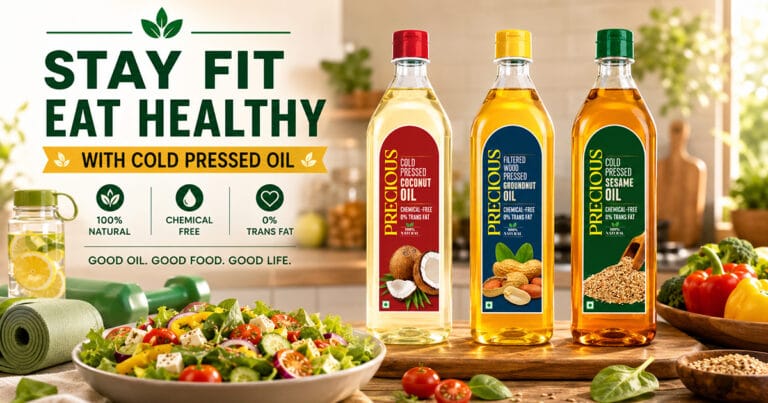
For a practical guide to the right oil for your kitchen, read India’s best cold pressed cooking oil guide. And if you want to make healthy cooking a lifestyle habit, our piece on staying fit and eating healthy with cold pressed oils is the perfect next read.
Explore the full range of Precious cold pressed cooking oils and taste the difference that authentically unrefined oil makes — in your kitchen, in your health, and in every meal you cook for the people you care about.
Try These Recipes with Precious Cold Pressed Oil

Written by
Suren is the co-founder of KN Agro Concepts and the creator of Precious cold-pressed oils. Based in Tamil Nadu, he has spent years working directly with traditional Mara Chekku wood-press artisans to bring authentic, chemical-free oils from Coimbatore to health-conscious families across India. He writes about cold-pressed oil, traditional Indian food practices, and the science of natural nutrition.
Follow on Facebook →
2 Comments