
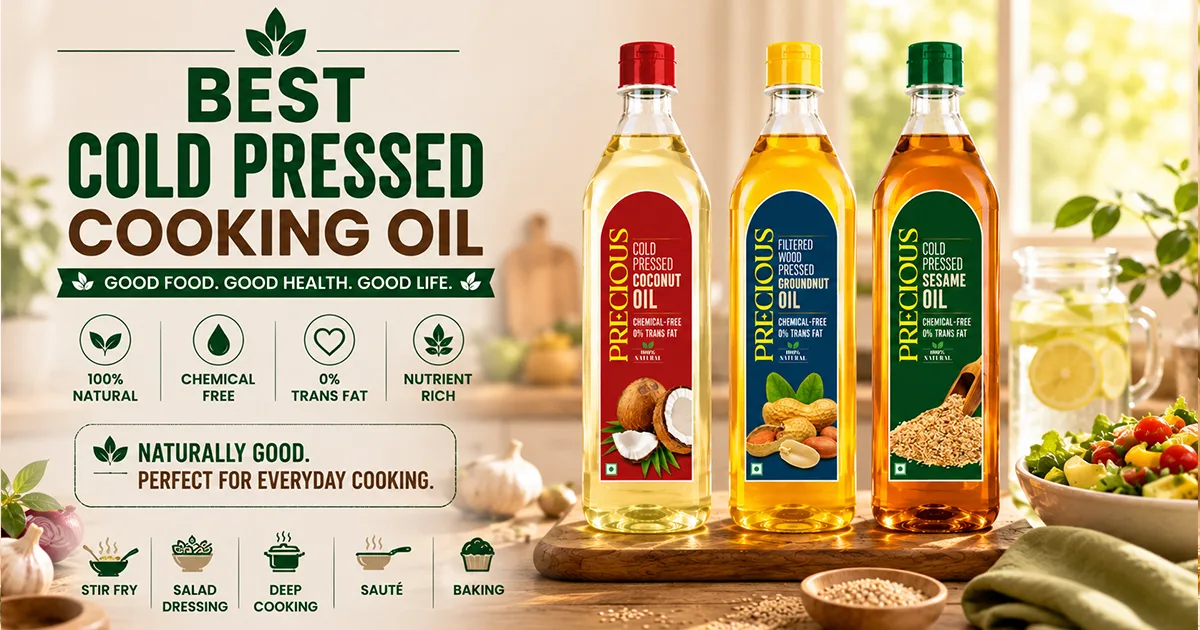
Best Cold Pressed Cooking Oil in India: The Complete Guide
Finding the best cold pressed cooking oil in India is no longer a niche pursuit — it is one of the most searched kitchen questions among health-conscious Indian families. And for good reason. The oil you use every single day, across every single meal, has a more cumulative impact on your nutrition than almost any other food choice you make. This guide covers everything you need to know to choose the best cold pressed cooking oil for your kitchen, your health, and your cooking style.
Quick Answer: The best cold pressed cooking oil for Indian kitchens is one that is genuinely wood-pressed at below 45°C, retains 100% of its natural Vitamin E, antioxidants, and flavour, and is made from high-quality seeds with no chemical solvents. Precious cold pressed cooking oils — groundnut, sesame, and coconut — are made using the traditional Mara Chekku wooden press in Tamil Nadu and meet every one of these criteria.
Contents
- 1 What Makes a Cold Pressed Cooking Oil the Best?
- 2 Cold Pressed Cooking Oil vs Refined Oil: Why It Matters
- 3 The Precious Cold Pressed Cooking Oil Range
- 4 Health Benefits of the Best Cold Pressed Cooking Oil
- 5 Best Cold Pressed Cooking Oil for Each Type of Indian Dish
- 6 Best Cold Pressed Cooking Oil: How to Use It Correctly
- 7 How to Identify the Best Cold Pressed Cooking Oil — And Spot the Fakes
- 8 How the Best Cold Pressed Cooking Oil Is Made: The Mara Chekku Process
- 9 Storing Cold Pressed Cooking Oil to Preserve Quality
- 10 Best Cold Pressed Cooking Oil: Frequently Asked Questions
- 10.1 Which is the best cold pressed cooking oil for everyday Indian cooking?
- 10.2 Can I use cold pressed cooking oil for deep frying?
- 10.3 Is cold pressed cooking oil better than refined oil for health?
- 10.4 How many times can I use cold pressed cooking oil for frying?
- 10.5 What is the difference between wood-pressed and cold-pressed oil?
- 10.6 How do I know if my cold pressed cooking oil has gone rancid?
- 10.7 Is cold pressed cooking oil safe for children and the elderly?
- 10.8 How much cold pressed cooking oil should I use per day?
- 11 Best Cold Pressed Cooking Oil: The Precious Range at a Glance
- 12 Conclusion: Why the Best Cold Pressed Cooking Oil Is the Simplest Upgrade Your Kitchen Can Make
- 13 Further Reading on Cold Pressed Oils
What Makes a Cold Pressed Cooking Oil the Best?
Before evaluating any specific oil, it is worth establishing what “best” actually means in the context of cold pressed cooking oil. There are five criteria that distinguish a genuinely superior product from the many impostors on the Indian market:
- Extraction temperature: True cold pressed cooking oil is extracted below 45°C. Above this temperature, Vitamin E begins to degrade, antioxidants are destroyed, and the oil starts to lose its nutritional identity. Look specifically for “wood-pressed” or Mara Chekku on the label — wooden presses stay cooler than metal equivalents because wood absorbs friction heat rather than transmitting it.
- Seed quality: Cold pressing has no chemical correction stage. If the source seed is inferior, the oil will reflect that directly. The best cold pressed cooking oil brands source premium seeds — in Precious’s case, handpicked Tamil Nadu groundnuts, sesame, and coconut.
- No chemical additives: Genuine cold pressed cooking oil has one ingredient: the seed. No hexane. No bleaching agents. No synthetic preservatives. No added colour or flavour. Check the ingredient list before buying.
- Authentic filtration: Cold pressed cooking oil should be filtered through cotton cloth or settling — not through chemical clarification. A small amount of natural cloudiness or sediment is a positive sign, not a defect.
- Verifiable authenticity: It must pass the smell test. Open the bottle. The best cold pressed cooking oil smells powerfully of its source: peanuts for groundnut, earthy nuttiness for sesame, fresh coconut for coconut oil. No smell means refined or adulterated.
Precious scores at the top on all five criteria. This guide explains exactly why — and how to use each Precious cold pressed cooking oil to maximum effect in your kitchen.
Cold Pressed Cooking Oil vs Refined Oil: Why It Matters
The cold pressed cooking oil vs refined oil debate is not a close contest nutritionally. To understand why the best cold pressed cooking oil is worth choosing, you need to understand what refining actually does to an oil.
Refined oil is extracted using hexane (a petroleum-based solvent), then processed through bleaching (removes natural colour and beneficial plant compounds), high-temperature deodorising at up to 260°C (removes all flavour and creates trace trans fats), and finally synthetic preservatives are added because the natural antioxidants have been destroyed.
The result is an oil that is nutritionally inert: it provides fat and calories, but the Vitamin E, antioxidants, phytosterols, and flavour compounds that the seed contained are gone.
The best cold pressed cooking oil, by contrast, retains:
- 100% of naturally occurring Vitamin E (tocopherols) — the primary fat-soluble antioxidant
- All active antioxidants — sesamol and sesamin in sesame, resveratrol in groundnut, polyphenols in coconut
- Natural phytosterols — plant compounds that block cholesterol absorption in the gut
- The full aromatic profile of the seed — which makes food taste genuinely better
- Zero trans fats, zero chemical residues, zero synthetic preservatives
For more on this comparison, read our detailed guide: Cold Pressed Oil vs Refined Oil: The Truth Your Kitchen Deserves.
The Precious Cold Pressed Cooking Oil Range
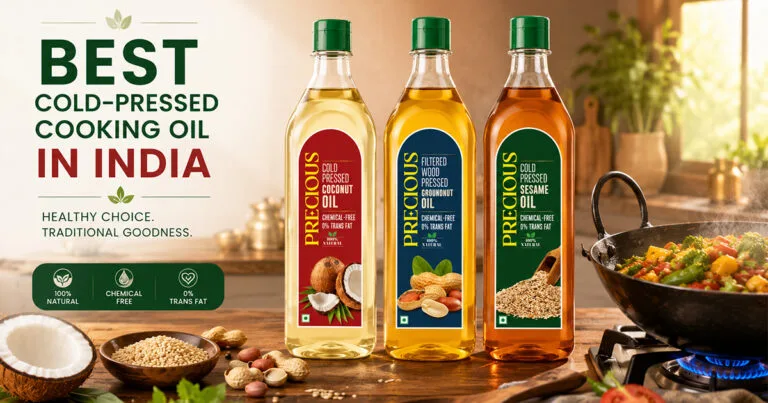
Precious makes three cold pressed cooking oils, each using the traditional Mara Chekku wooden press. Together they cover every cooking need in the Indian kitchen. Here is a complete profile of each.
1. Precious Wood-Pressed Groundnut Oil — The Best Cold Pressed Cooking Oil for Everyday Use
This is the most versatile cold pressed cooking oil in the Precious range — and the one most Indian kitchens should start with. Made from premium Tamil Nadu groundnuts pressed slowly through a wooden ghani, this oil emerges at room temperature with its full natural character intact.
Why it is the best cold pressed cooking oil for everyday Indian cooking:
- Fatty acid profile: Approximately 46% monounsaturated fat (oleic acid / Omega-9) — the same heart-healthy fat that makes olive oil famous. Actively lowers LDL cholesterol while maintaining HDL.
- Resveratrol: Present in cold-pressed groundnut oil and absent in refined versions. This compound, also found in red wine, inhibits LDL oxidation, acts as a vasodilator, and reduces platelet clumping.
- Vitamin E: Fully retained — provides antioxidant protection in the oil itself (extending freshness naturally) and in the body after consumption.
- Phytosterols: Intact — beta-sitosterol and other plant sterols block dietary cholesterol absorption.
- Smoke point: ~160°C — compatible with all standard Indian cooking including deep frying, shallow frying, tadka, and sautéing.
- Flavour: Warm, rich, unmistakably peanut — a flavour that transforms everyday dal and curry.
Best for: All everyday cooking — curries, dal, sabzi, tadka, deep frying, shallow frying. The authentic base for Chettinad cooking and Tamil Nadu festival snacks.
2. Precious Cold Pressed Sesame Oil — The Best Cold Pressed Cooking Oil for Heart Health
Sesame oil is the most intensively studied Indian cooking oil for cardiovascular health. The key is in its unique lignans — sesamol, sesamin, and sesamolin — that exist only in sesame and are completely destroyed during refining. Precious Cold Pressed Sesame Oil retains all of them.
Why it is the best cold pressed cooking oil for South Indian cuisine and wellness:
- Sesame lignans (sesamol, sesamin): Multiple clinical studies have shown these compounds reduce LDL cholesterol, prevent LDL oxidation, and produce modest but consistent blood pressure reductions. Available only in cold pressed sesame oil.
- Fatty acid balance: ~45% Omega-6 (linoleic acid) balanced with ~40% Omega-9 (oleic acid) — one of the most balanced PUFA/MUFA profiles of any cooking oil.
- Vitamin E and Vitamin K: Both retained in meaningful amounts.
- Zinc: Supports collagen production and wound healing.
- Natural preservative action: Sesamol acts as a powerful natural antioxidant, giving cold pressed sesame oil the longest natural shelf life of the three Precious oils.
Best for: South Indian tempering (vatha kuzhambu, kootu, poriyal), pickles, raw drizzle over curd rice, oil pulling, Ayurvedic massage.
To understand the specific heart health benefits, read: Are Cold Pressed Oils Good for the Heart?
3. Precious Cold Pressed Coconut Oil — The Best Cold Pressed Cooking Oil for Kerala Cuisine
Made from carefully selected mature coconuts pressed through the wooden Mara Chekku at below 45°C, Precious Cold Pressed Coconut Oil is the authentic choice for Kerala-style cooking, baking, and traditional wellness applications.
Why it is the best cold pressed cooking oil for coconut-based Indian cuisine:
- Lauric acid (MCT): ~50% of the fat content. Medium-chain triglycerides are metabolised directly for energy rather than stored. Lauric acid also raises HDL (good) cholesterol and has antimicrobial properties.
- Capric and caprylic acid: Additional MCTs supporting gut health and immediate energy.
- Polyphenols: Retained only in cold pressed coconut oil — anti-inflammatory, antioxidant.
- Vitamin E: Present and intact.
- Aroma: Sweet, fresh, unmistakably coconut — the defining flavour of Avial, Thoran, and Appam.
Note on solidification: Precious Coconut Oil solidifies below ~24°C — this is normal and a sign of purity. Place the bottle in warm water to liquefy.
Best for: Kerala curries (Avial, Thoran, fish curry), baking, baby massage, oil pulling, skin and hair care.
Health Benefits of the Best Cold Pressed Cooking Oil
The health benefits of cold pressed cooking oil flow directly from what the extraction process preserves. Here is a systematic breakdown for each key benefit area:
Heart Health
The best cold pressed cooking oil supports cardiovascular health through three simultaneous mechanisms: the monounsaturated and polyunsaturated fats lower LDL cholesterol; the natural antioxidants (Vitamin E, sesamol, resveratrol) prevent LDL oxidation — the process that actually causes arterial plaque; and phytosterols block dietary cholesterol absorption in the gut. For cholesterol-specific information, see our guide: Best Oil for Cholesterol Control.
Anti-Inflammatory Protection
Chronic inflammation is the root cause of most lifestyle diseases — heart disease, type 2 diabetes, and age-related cognitive decline. The natural polyphenols and tocopherols in Precious cold pressed cooking oils directly counter inflammatory cytokines (cellular signals that trigger inflammation). Refined oils, which lack these compounds entirely, offer no such protection.
Immune Function
Vitamin E — fully retained in cold pressed cooking oil, largely destroyed in refined oil — is essential for normal T-cell activity and the integrity of mucous membranes. Daily cooking with Precious cold pressed oil contributes meaningfully to your body’s baseline antioxidant status and immune capacity.
Digestive Health
Cold pressed cooking oil retains natural lecithin — a fat emulsifier present in seeds that is removed during refining. Lecithin supports the emulsification of dietary fat in the digestive system, which is why traditional Indian food cooked in chekku oil was considered gentler on the stomach than modern refined oil alternatives.
Skin and Hair
The Vitamin E, natural fatty acids, and antioxidants in Precious cold pressed oils nourish skin and hair both from the inside (eaten) and outside (applied). Precious Sesame Oil is the traditional Ayurvedic body massage oil. Precious Coconut Oil has been scientifically confirmed to penetrate the hair shaft uniquely well, reducing protein loss and preventing damage.
Best Cold Pressed Cooking Oil for Each Type of Indian Dish
Choosing the best cold pressed cooking oil for a specific dish is about matching the oil’s flavour profile and heat tolerance to the cooking method. Here is a complete reference:
| Dish / Cooking Method | Best Precious Cold Pressed Oil | Why |
|---|---|---|
| Everyday dal, sabzi, curry | Groundnut Oil | Versatile, high smoke point, rich MUFA |
| South Indian tadka / tempering | Sesame Oil | Traditional flavour, sesamol antioxidants |
| Deep frying (pakora, murukku, puri) | Groundnut Oil | Highest smoke point (~160°C), oxidative stability |
| Shallow frying | Groundnut Oil | Stable at 150–170°C |
| Kerala dishes (Avial, Thoran, fish) | Coconut Oil | Authentic flavour, MCT fats |
| Baking (cookies, banana bread) | Coconut Oil | Excellent butter substitute |
| Pickles and preserves | Sesame Oil | Acts as natural preservative via sesamol |
| Salad dressing / raw drizzle | Sesame or Groundnut Oil | Maximum antioxidant delivery without heat |
| Chettinad and Tamil Nadu dishes | Groundnut Oil | Traditional authentic base for the cuisine |
| Ayurvedic massage and oil pulling | Sesame Oil | Traditional Abhyanga and kavala oil |
Best Cold Pressed Cooking Oil: How to Use It Correctly
The best cold pressed cooking oil is not fragile — Indian cooks have fried, tempered, and sautéed in these oils for generations. But a few simple practices will help you get maximum nutritional and flavour benefit from every bottle:
Use Medium Heat as Your Default
Cold pressed cooking oil heats faster than refined oil because it is not padded with industrial stabilisers. Medium flame is sufficient for the vast majority of Indian cooking. The oil will be ready quicker than you expect. Adjust to the oil, not the other way around.
The Smoke Signal
If your Precious Groundnut Oil begins to smoke, it is signalling that the heat is above ~160°C. Reduce the flame. This is a useful, natural feedback signal — refined oils engineered to withstand 230°C give you no such warning while silently producing degradation compounds at lower temperatures.
Use Less Than You Think
The rich flavour of authentic cold pressed cooking oil means you naturally reach satisfaction with a smaller quantity. A tablespoon of Precious Groundnut Oil does the flavour work of two tablespoons of a neutral refined oil. Over time, this partially offsets the higher per-litre cost.
Raw Use for Maximum Nutrition
Drizzling cold pressed cooking oil over finished dishes — curd rice, cooked vegetables, rice and dal — delivers the full antioxidant content without any heat degradation. This is how sesamol and resveratrol are best delivered to the body. Try one tablespoon of Precious Sesame Oil as a raw finish on your daily rice dish.
Do Not Reuse
Cold pressed cooking oil used for deep frying should be discarded after one use. Reheating any oil multiple times creates oxidised fats and degrades the natural antioxidants. The flavour difference between fresh and reused oil will also be obvious.
How to Identify the Best Cold Pressed Cooking Oil — And Spot the Fakes
The Indian market is full of oils that claim to be cold pressed, Mara Chekku, or Kachi Ghani but are not. The term is not tightly regulated. Here is a definitive identification guide for the best cold pressed cooking oil:
The Smell Test (Most Reliable)
Open any bottle claiming to be cold pressed cooking oil and smell it. The result is immediate and definitive:
- Groundnut oil: Should smell powerfully of fresh peanuts. Like holding a handful of just-roasted groundnuts under your nose.
- Sesame oil: Should have an intensely earthy, nutty aroma. Unmistakable. You will know it immediately.
- Coconut oil: Should smell sweet and tropical. Like fresh coconut or coconut milk.
If there is no smell, or a chemical odour, or a generic vegetable smell — the oil has been refined or adulterated, regardless of what the label says.
The Colour Test
- Groundnut cold pressed oil: Rich golden yellow. Not pale straw, not colourless.
- Sesame cold pressed oil: Deep amber to dark gold.
- Coconut cold pressed oil: Crystal white when solid, clear liquid when warm.
Pale or colourless oils of any type have been bleached. Bleaching removes colour — and with it, the plant compounds that gave the colour in the first place.
The Sediment Test
A slight natural cloudiness or fine sediment at the bottom of a cold pressed cooking oil bottle is a positive sign. This is residue from cotton cloth filtration — proof that no chemical clarification was used. It is harmless and can be swirled in or filtered before use if you prefer clarity.
The Price Test
Genuine cold pressed cooking oil extracts only 50–60% of available oil from a seed, versus 99% for chemical extraction. You need 2–3 times more seeds per litre. If a cold pressed cooking oil is priced at or near refined oil price, the extraction method does not match the claim.
The Label Test
Look specifically for: Mara Chekku, Kachi Ghani, or “wood-pressed.” The ingredient list should have one item: the seed name. Any additives, preservatives, or flavour enhancers indicate processing. Learn more: What Is Cold Pressed Oil? The Complete Guide.
How the Best Cold Pressed Cooking Oil Is Made: The Mara Chekku Process
Understanding the process helps you evaluate any cold pressed cooking oil you encounter. The Mara Chekku — Tamil for “wooden press” — is the most temperature-gentle extraction method available:
- Seed selection: Premium seeds are sourced and inspected. Since there is no bleaching or correction stage, the seed quality directly determines oil quality.
- Loading: Seeds are placed into the wooden mortar of the ghani.
- Slow pressing: A hardwood shaft rotates slowly inside the mortar. Both surfaces being wood means friction heat is absorbed rather than transmitted. The oil emerges at room temperature — below 45°C.
- Natural settling: The raw oil settles in tanks as seed particles sink by gravity.
- Cloth filtration: The oil is strained through clean cotton cloth. No chemicals, no centrifuge, no clarifying agents.
- Bottling: The finished cold pressed cooking oil goes directly into bottles with no preservatives added. The natural Vitamin E and antioxidants act as the preservation system.
This is exactly how Precious produces every batch. The simplicity of the process is the point — fewer steps means fewer opportunities to damage the oil’s nutritional integrity.
Storing Cold Pressed Cooking Oil to Preserve Quality
The best cold pressed cooking oil is a genuine food product, not an industrially engineered chemical designed for 24-month shelf life. Treat it accordingly:
- Keep away from direct sunlight: UV light degrades antioxidants. Store in a dark cupboard or pantry, not on a sunny kitchen shelf.
- Keep away from heat: Do not store next to the stove or above the oven. Room temperature or slightly cool is ideal.
- Seal after every use: Oxygen is the primary cause of rancidity. Close the cap firmly after every pour.
- Use within 6–9 months of opening: Precious Sesame Oil can last up to 12 months due to its exceptional sesamol antioxidant content. Groundnut and Coconut are best within 6–9 months of opening.
- Coconut oil solidification: Normal below ~24°C. Place the bottle in a bowl of warm water to liquefy. Do not microwave.
- Trust your nose: Fresh cold pressed cooking oil smells of its seed. Rancid oil smells sharp, acrid, or chemical. If in doubt, discard and replace.
Best Cold Pressed Cooking Oil: Frequently Asked Questions
Which is the best cold pressed cooking oil for everyday Indian cooking?
Precious Wood-Pressed Groundnut Oil is the most versatile choice for everyday Indian cooking. Its smoke point (~160°C) handles all standard Indian cooking methods. Its high MUFA content (~46% oleic acid) supports heart health. Its resveratrol and Vitamin E provide antioxidant protection. And its authentic peanut flavour enhances every dish it touches.
Can I use cold pressed cooking oil for deep frying?
Yes — specifically Precious Groundnut Oil with its ~160°C smoke point. Standard Indian deep frying occurs at 160–175°C, making this entirely compatible. Keep the temperature steady and do not overheat. Discard the oil after one frying session.
Is cold pressed cooking oil better than refined oil for health?
Significantly better. The best cold pressed cooking oil retains Vitamin E, antioxidants, phytosterols, and natural fatty acids that refined processing destroys. These compounds support heart health, reduce inflammation, protect against LDL oxidation, and provide real nutritional value that refined oil cannot deliver. See our detailed comparison: Cold Pressed Oil vs Refined Oil.
How many times can I use cold pressed cooking oil for frying?
Once. Reusing any oil — including the best cold pressed cooking oil — degrades the fatty acids, destroys the remaining antioxidants, and creates oxidised compounds that are harmful to health. Use fresh oil every time you fry.
What is the difference between wood-pressed and cold-pressed oil?
Wood pressing is the highest-quality form of cold pressing. Metal expeller presses labelled as “cold-pressed” still reach 45–70°C through friction. Wood pressing stays below 45°C because wood absorbs heat. Precious uses wooden presses specifically, not metal expellers, giving you the most temperature-gentle cold pressed cooking oil available.
How do I know if my cold pressed cooking oil has gone rancid?
Fresh Precious Groundnut Oil smells like peanuts. Rancid oil smells sharp, acrid, or chemical. Trust your nose — it is more sensitive than any lab test for detecting rancidity in cold pressed cooking oil. If the aroma has changed from fresh-seed to chemical, replace the bottle.
Is cold pressed cooking oil safe for children and the elderly?
Yes. Precious cold pressed cooking oils are 100% natural, FSSAI compliant, and free from chemical additives, synthetic preservatives, and trans fats. They are suitable for all ages. Those with nut allergies should consult a doctor regarding groundnut oil; sesame and coconut oils are generally well tolerated.
How much cold pressed cooking oil should I use per day?
Two to three tablespoons per person per day is a reasonable target for adults cooking three meals. The rich flavour of the best cold pressed cooking oil means you naturally use slightly less per dish than you would with a neutral refined oil.
Best Cold Pressed Cooking Oil: The Precious Range at a Glance
Here is a quick summary of the three Precious cold pressed cooking oils — their strengths, best uses, and where to buy:
| Oil | Key Nutrients | Smoke Point | Best For |
|---|---|---|---|
| Groundnut Oil | MUFA 46%, Vitamin E, Resveratrol | ~160°C | Everyday cooking, frying |
| Sesame Oil | Sesamol, Sesamin, Vitamin E, K | ~177°C | South Indian, pickles, wellness |
| Coconut Oil | Lauric acid (MCT), Polyphenols | ~177°C | Kerala cuisine, baking, beauty |
For a complete buying guide to India’s cold pressed oil landscape, read: India’s Best Cold-Pressed Cooking Oil: A Complete Buying Guide.
Conclusion: Why the Best Cold Pressed Cooking Oil Is the Simplest Upgrade Your Kitchen Can Make
Switching to the best cold pressed cooking oil does not require a new diet plan, new recipes, or new kitchen equipment. It requires choosing a different bottle — one that smells of what it contains, looks the colour it should be, and retains everything nature put into the seed.
The Precious cold pressed cooking oil range — groundnut, sesame, and coconut — covers every Indian cooking need. From everyday dal and curry to festival frying, South Indian tempering, and Kerala-style cuisine, these three oils have been the backbone of Indian cooking for thousands of years. They still are. The difference is that Precious makes them available to your doorstep with the same authenticity that once required a visit to the village chekku kadai.
The best cold pressed cooking oil is not a luxury. It is what cooking oil is supposed to be.
Ready to upgrade your kitchen? Shop the full Precious cold pressed cooking oil range at precious.farm/shop
For a taste of our traditional extraction story, read our piece on traditional marachekku oils from Coimbatore — the centuries-old Tamil Nadu method behind Precious oils. And if wellness-first cooking is your goal, our guide on how to stay fit with cold pressed oils is a great next read.
Further Reading on Cold Pressed Oils
- What Is Cold Pressed Oil? The Complete Guide for Indian Consumers
- Cold Pressed Oil vs Refined Oil: The Truth Your Kitchen Deserves
- Are Cold Pressed Oils Good for the Heart?
- Best Oil for Cholesterol Control
- India’s Best Cold-Pressed Cooking Oil: A Complete Buying Guide
External References: NCBI: Dietary fat and cardiovascular health | FSSAI Edible Oil Regulations | National Institute of Nutrition India
Disclaimer: This article is for educational purposes only. All Precious products comply with FSSAI regulations. Consult a qualified nutritionist or healthcare professional for specific dietary advice.
Try These Recipes with Precious Cold Pressed Oil

Written by
Suren is the co-founder of KN Agro Concepts and the creator of Precious cold-pressed oils. Based in Tamil Nadu, he has spent years working directly with traditional Mara Chekku wood-press artisans to bring authentic, chemical-free oils from Coimbatore to health-conscious families across India. He writes about cold-pressed oil, traditional Indian food practices, and the science of natural nutrition.
Follow on Facebook →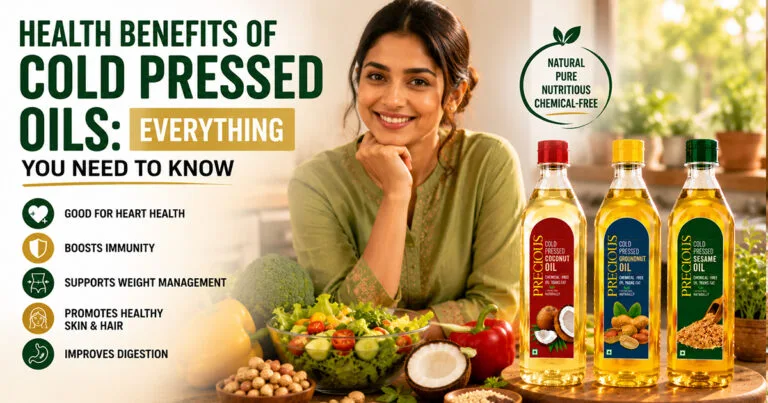


2 Comments