
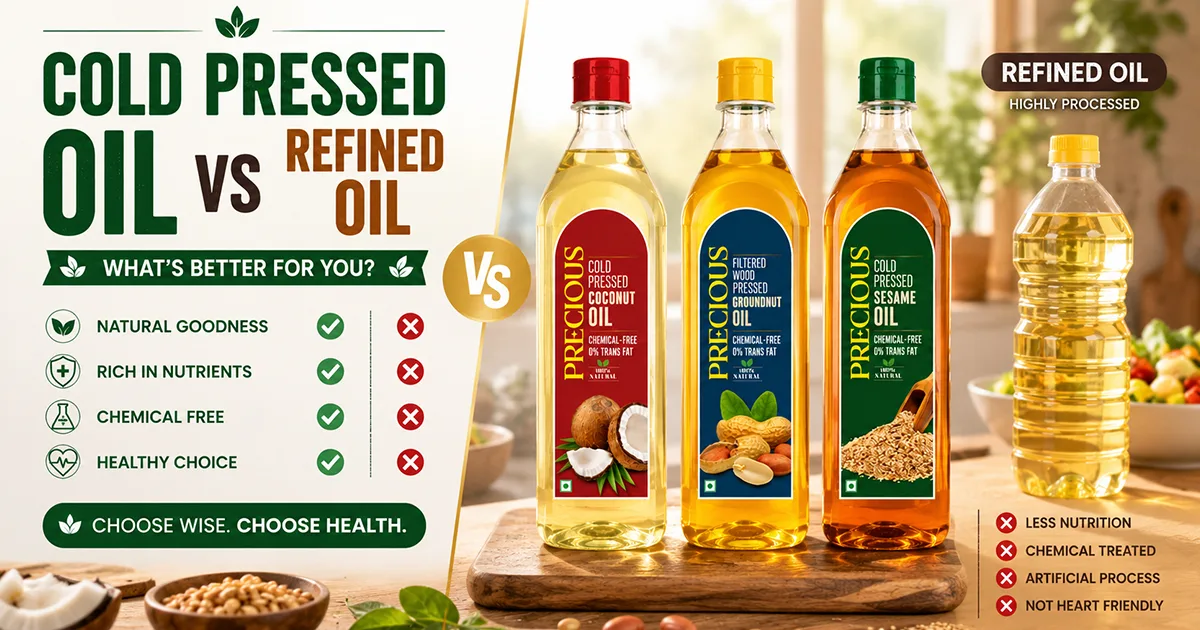
Cold Pressed Oil vs Refined Oil: The Truth Your Kitchen Deserves
The debate of cold pressed oil vs refined oil comes down to one question: do you want oil that retains 100% of its natural nutrition, or oil that has been chemically processed until nothing beneficial remains?
Quick Answer: The main difference between cold pressed oil and refined oil is how they are made. Cold pressed oil is extracted by slowly crushing seeds at low temperatures — no heat, no chemicals. Refined oil is extracted using chemical solvents and high heat, stripping away all natural vitamins and flavour. Precious cold-pressed oils (groundnut, sesame, coconut) are made using the traditional wood-press method, giving you 100% natural nutrition that refined oil simply cannot match.
You have probably heard a lot about cold-pressed oil lately. Health blogs mention it. Nutrition experts talk about it. Even your mother’s friends at the kitty party are switching to it. But what exactly is the difference between cold-pressed oil and the regular refined oil sitting in your kitchen right now? And is the difference really worth it?
In this guide, we lay out the full, honest truth — no marketing fluff. Just a clear, science-backed comparison of cold-pressed oil vs refined oil, and why more Indian families are choosing Precious cold-pressed cooking oils as their daily staple.
Contents
- 1 The Story of Two Oils
- 2 Cold Pressed vs Refined Oil: The Full Comparison
- 3 What You Are Really Eating: A Nutritional Deep Dive
- 4 The Smoke Point Myth: Addressing the Biggest Misconception
- 5 Meet the Precious Collection: Three Oils, Three Stories
- 6 The Price Question: Is Cold-Pressed Oil Worth the Extra Cost?
- 7 How to Spot Real Cold-Pressed Oil
- 8 Cold-Pressed Oil for Heart Health: The Science
- 9 Cold-Pressed Oil in Your Daily Life: Practical Guide
- 10 Common Myths About Cold-Pressed Oil: Debunked
- 11 Frequently Asked Questions
- 11.1 Is cold-pressed oil better than refined oil for cooking?
- 11.2 What is the difference between wood-pressed and cold-pressed oil?
- 11.3 Can I use cold-pressed oil for deep frying?
- 11.4 Does refined oil cause cancer or other diseases?
- 11.5 Is cold-pressed oil safe for everyone?
- 11.6 How do I know if my cold-pressed oil has gone bad?
- 12 Conclusion: The Switch Worth Making
- 13 Cold Pressed Oil vs Refined Oil: The Verdict for Indian Kitchens
The Story of Two Oils
To understand why these two types of oil are so different, you need to understand how they are made. The extraction method determines everything — the nutrition, the flavour, the safety, and the price.
How Cold-Pressed Oil Is Made
Cold-pressed oil making is one of humanity’s oldest food crafts. In India, it has been practised for thousands of years under names like Mara Chekku (Tamil Nadu), Kachi Ghani (North India), and Ghani press (various regions).
The process is beautifully simple:
- Select quality seeds: The seeds (groundnuts, sesame, coconuts) are handpicked and cleaned. Since no chemicals or bleaching will happen later, the quality of the seed determines the quality of the oil entirely.
- Press slowly: The seeds are fed into a wooden mortar and pestle that rotates slowly. Because the rotation speed is low and the surfaces are wood (which absorbs rather than generates heat), the oil comes out at room temperature — typically below 45°C.
- Filter naturally: The raw oil is settled in tanks so heavier particles sink. Then it is strained through cotton cloth. No chemicals, no centrifuges, no bleaching agents.
- Bottle: The finished oil goes directly into bottles. What you receive is the pure, first-press oil from the seed — with everything nature put into it still intact.
This is exactly how Precious makes every batch. Our Mara Chekku process keeps the oil at room temperature throughout, preserving 100% of the natural Vitamin E, antioxidants, healthy fats, flavour, and aroma.
How Refined Oil Is Made
Refined oil is an industrial product. It is engineered for efficiency, long shelf life, and a neutral appearance — not for nutritional value. Here is the real process, step by step:
- Chemical extraction (Hexane): Seeds are washed in hexane — a solvent derived from petroleum, closely related to gasoline. Hexane is incredibly effective at dissolving oil from seeds, extracting 99% of the available oil. It is also toxic when inhaled and not something you want residue of in your food. While manufacturers aim to remove all hexane through boiling, trace amounts can remain.
- Boiling: The oil-hexane mix is heated to high temperatures (up to 200°C) to evaporate the solvent. This step destroys most of the naturally occurring Vitamin E, antioxidants, and beneficial plant compounds (phytosterols, lignans).
- Degumming: Phosphoric acid is added to remove natural gums and phospholipids from the oil. These are actually beneficial compounds — but they make the oil look murky, so out they go.
- Bleaching: Activated clay or chemical agents are used to remove the natural colour of the oil. Natural groundnut oil is a rich golden yellow. Refined groundnut oil is almost colourless. That colour change tells you how much has been stripped away.
- Deodorising: By this point, the oil smells terrible — chemical, rancid, and unpleasant. High-pressure steam at temperatures up to 260°C removes all the smell. It also removes all the flavour. This step can create small amounts of harmful trans fats.
- Synthetic preservatives added: Without natural antioxidants (destroyed in step 2), the oil would spoil quickly. Synthetic preservatives like TBHQ (tertiary butylhydroquinone) are added to extend shelf life to 18–24 months.
The end result? A crystal-clear, odourless, flavourless liquid that contains fat and calories — but almost no nutritional value. The “good stuff” — vitamins, antioxidants, plant sterols, natural aroma compounds — has been cooked, bleached, and chemically processed away.
Cold Pressed vs Refined Oil: The Full Comparison
Let us put the key differences side by side:
| Category | Precious Cold-Pressed Oil | Refined Oil |
|---|---|---|
| Extraction temp | Below 45°C (room temperature) | Up to 260°C (industrial heat) |
| Chemicals used | None | Hexane, phosphoric acid, bleaching clay |
| Vitamin E | Fully retained (100%) | Mostly destroyed (10–20% remains) |
| Antioxidants | Preserved — sesamol, resveratrol, phytosterols | Destroyed by heat processing |
| Trans fats | Zero (no high-heat processing) | Small amounts can form during deodorising |
| Natural colour | Rich gold / amber — natural | Almost colourless (bleached) |
| Flavour and aroma | Rich, authentic, seed-like | None (deodorised) |
| Preservatives | None (natural antioxidants preserve it) | TBHQ and other synthetics added |
| Shelf life | 6–12 months (like fresh food) | 18–24 months (chemically extended) |
| Cholesterol impact | Helps lower LDL, supports HDL | Neutral at best; trans fats raise LDL |
What You Are Really Eating: A Nutritional Deep Dive
Let us look at what the two types of oil actually deliver to your body in every spoonful.
What Precious Cold-Pressed Oil Delivers
Precious Groundnut Oil (100ml contains approximately):
- Monounsaturated fat (oleic acid / Omega-9): ~46g — heart-healthy, cholesterol-lowering
- Polyunsaturated fat (linoleic acid / Omega-6): ~34g — essential for brain and cell function
- Saturated fat: ~18g — moderate and naturally balanced by the MUFA/PUFA ratio
- Vitamin E (tocopherols): Significant amount — protects cells, supports immunity
- Resveratrol: Present — heart-protective, blood pressure supporting
- Phytosterols: Present — block cholesterol absorption in the gut
Precious Sesame Oil (100ml contains approximately):
- Polyunsaturated fat (Omega-6): ~45g — supports heart health
- Monounsaturated fat (Omega-9): ~40g — anti-inflammatory
- Sesamol and sesamin (lignans): Significant amounts — powerful antioxidants unique to sesame
- Vitamin E: Well retained — immune and skin support
- Vitamin K: Present — bone health and blood clotting regulation
- Zinc: Present — collagen production, wound healing
Precious Coconut Oil (100ml contains approximately):
- Lauric acid (MCT / saturated): ~50g — antimicrobial, raises HDL cholesterol
- Other MCTs (capric, caprylic acid): ~16g — immediately burned for energy
- Vitamin E: Present — skin, immunity, antioxidant
- Polyphenols: Present — anti-inflammatory
What Refined Oil Delivers
After extraction, bleaching, deodorising, and preservative addition, refined oil delivers:
- Fat and calories (same as above, but unprotected by antioxidants)
- Minimal Vitamin E (80–90% destroyed by heat)
- No significant antioxidants
- Trace amounts of hexane solvent (amount debated; varies by brand and process)
- Small quantities of trans fats (from high-heat deodorising)
- Synthetic preservatives
Put simply: Precious cold-pressed oil is nutrition. Refined oil is just fat.
The Smoke Point Myth: Addressing the Biggest Misconception
The most common argument for refined oil is: “But cold-pressed oil has a lower smoke point — you can’t fry with it.”
This is a half-truth that misleads many people. Let us look at the full picture.
What Is Smoke Point?
Smoke point is the temperature at which an oil begins to smoke visibly. Above this temperature, the oil degrades and can produce harmful compounds. Refined oils have higher smoke points (around 220–230°C) because everything that burns or smokes at lower temperatures has been removed through processing.
What Temperature Does Indian Cooking Actually Need?
Most Indian cooking happens at:
- Tadka / tempering: 150–170°C
- Stir-frying: 150–180°C
- Shallow frying: 160–180°C
- Deep frying: 160–180°C
- Sautéing: 120–160°C
Precious Wood-Pressed Groundnut Oil has a smoke point of approximately 160–170°C — right in the range of normal Indian cooking. You can absolutely fry puris, pakoras, murukku, and vadas with it.
The More Important Question: Oxidative Stability
Smoke point tells you when the oil smokes. Oxidative stability tells you how quickly the oil degrades and produces harmful compounds when heated. This is the more important number for health.
Refined oils may not smoke until 230°C, but they degrade silently and quickly because they lack antioxidant protection. Precious cold-pressed oils, protected by their natural Vitamin E and other antioxidants, are far more resistant to degradation even at cooking temperatures. They do not produce harmful oxidation byproducts as quickly as their refined counterparts.
The smoking oil is telling you to reduce your heat. Refined oil that does not smoke might be silently producing harmful free radicals at the same temperature. Which would you rather know about?
Meet the Precious Collection: Three Oils, Three Stories
Precious Wood-Pressed Groundnut Oil
Made from premium Tamil Nadu groundnuts, pressed slowly in a wooden churner with no heat or chemical contact. Golden yellow, fragrant with fresh peanut aroma, rich in heart-healthy MUFA, Vitamin E, and the rare antioxidant resveratrol. The most versatile of the Precious range — suitable for everyday frying, sautéing, tempering, and even as a dressing.
Open a bottle and smell it. If it smells like peanuts, it is real. Precious Groundnut Oil smells exactly like fresh roasted peanuts — because it is.
Precious Cold-Pressed Sesame Oil
Deep amber, earthy, and unmistakably aromatic. Made from handpicked sesame seeds pressed without heat or solvents. Contains sesame’s exclusive lignans (sesamol, sesamin) that no refining process can preserve. Essential for authentic South Indian cooking, pickles, oil pulling, and traditional Ayurvedic massage.
The defining flavour of vatha kuzhambu, Avakkai pickle, and idli podi comes from this oil — and only from a cold-pressed version that has not been stripped of its character.
Precious Cold-Pressed Coconut Oil
Extracted from fresh coconuts using a wooden ghani. Solid white at room temperature, clear liquid when warmed. Sweet, tropical aroma. Rich in lauric acid and MCTs that support metabolism, immunity, and brain function. A beloved ingredient for Kerala-style cooking, baking, beauty care, and infant massage.
Solidification below 24°C is a mark of purity, not spoilage. Simply place the bottle in warm water to liquefy.
The Price Question: Is Cold-Pressed Oil Worth the Extra Cost?
Yes. Here is the straightforward reason why.
Chemical extraction methods pull out 99% of the oil from every seed using hexane. Cold pressing extracts only 50–60% — the rest stays in the seed cake. That means you need 2–3 times more seeds to produce the same volume of cold-pressed oil. More raw material + slower process + no chemical shortcuts = higher price.
But consider what you get for that extra cost:
- 100% of the Vitamin E (vs 10–20% in refined)
- Active antioxidants that protect you from cellular aging
- Zero chemical residues
- Zero trans fats
- Real, authentic flavour that makes you use less oil
And because Precious cold-pressed oils are more flavourful, you naturally use less of them. A tablespoon of Precious Groundnut Oil delivers more flavour and nutrition than two tablespoons of a refined alternative. When you factor in actual usage, the effective price difference is often smaller than it appears on the shelf.
How to Spot Real Cold-Pressed Oil
The market is full of oils that claim to be cold-pressed but are not. Here is a simple checklist to verify authenticity:
- Smell: Open the bottle. It should smell strongly of the source ingredient. Groundnut oil should smell like peanuts. Sesame oil should have a distinct earthy, nutty aroma. If there is no smell, or it smells chemical — it has been refined or adulterated.
- Colour: Genuine cold-pressed groundnut oil is a rich golden yellow. Sesame oil is deep amber. Coconut oil is clear white. If they are pale or colourless, they have been bleached.
- Sediment: A small amount of natural cloudiness or sediment at the bottom is a positive sign. It means the oil was cloth-filtered, not chemically clarified. Refined oil is perfectly clear because all natural compounds have been removed.
- Price: Real cold-pressed oil costs more. If you see a litre of “cold-pressed groundnut oil” at the price of refined oil, it is not what it claims to be.
- Label: Look for words like “wood-pressed,” “Mara Chekku,” “Kachi Ghani,” or “expeller-pressed without heat.” Avoid oils that only say “cold-pressed” without specifying the extraction method — some expeller presses are labelled as cold-pressed despite generating significant heat.
Precious meets every one of these tests. Open any Precious bottle and the aroma tells you immediately that you are holding a genuinely unrefined product.
Cold-Pressed Oil for Heart Health: The Science
One of the most common reasons people switch to cold-pressed oil is heart health. Let us look at what the evidence says.
Cholesterol Management
The monounsaturated fats (MUFA) in Precious Groundnut Oil help lower LDL (bad) cholesterol and maintain HDL (good) cholesterol. This is the same mechanism by which olive oil became famous for heart health. Indian groundnut oil, properly pressed, delivers the same fats plus additional compounds like resveratrol that olive oil does not contain.
Precious Sesame Oil is particularly well-studied for cholesterol effects. Research has shown that diets including sesame oil significantly reduce total cholesterol and LDL cholesterol, largely due to its lignans (sesamol, sesamin, sesamolin) and its PUFA content.
Inflammation Reduction
Chronic inflammation in blood vessels is the root cause of most cardiovascular disease. The antioxidants in Precious cold-pressed oils — including Vitamin E across all three oils, sesamol in sesame oil, and resveratrol in groundnut oil — directly counter this inflammation at a cellular level.
Refined oils, which lack these antioxidants entirely, offer no such protection. Some refined oils high in Omega-6 fats (especially those that have degraded during processing) may actually contribute to inflammation when consumed regularly.
Blood Pressure
Studies on sesame oil consumption have shown modest but consistent reductions in blood pressure. The mechanism is believed to involve sesamol’s antioxidant action in blood vessels, which helps them remain more flexible and responsive. Precious Sesame Oil, with its fully preserved lignans, is the oil to reach for if blood pressure management is a priority.
Cold-Pressed Oil in Your Daily Life: Practical Guide
Which Precious Oil for Which Dish?
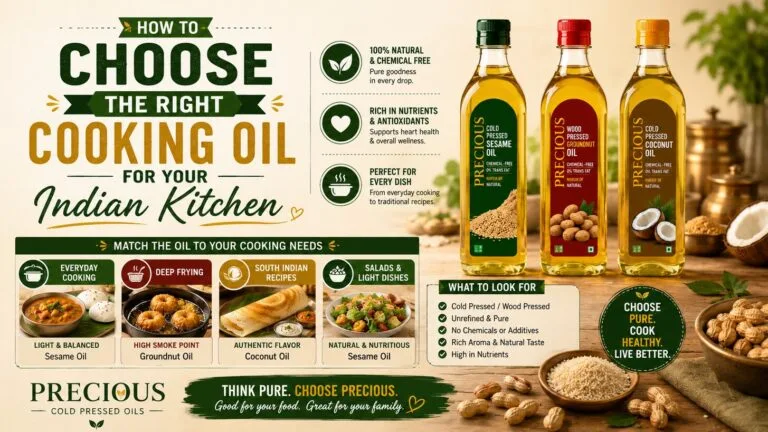
- Everyday curries, dal, sabzi: Precious Groundnut Oil — the most versatile, handles heat well
- South Indian dishes (sambar, rasam, poriyal): Precious Sesame Oil — the traditional choice
- Pickles and chutneys: Precious Sesame Oil — acts as a natural preservative
- Deep frying: Precious Groundnut Oil — stable at frying temperatures
- Baking: Precious Coconut Oil — excellent butter substitute
- Kerala dishes (Avial, Thoran): Precious Coconut Oil — the only authentic choice
- Salad dressings: Precious Sesame Oil or Groundnut Oil — drizzle raw for maximum flavour and nutrition
- Oil pulling and massage: Precious Sesame Oil — the Ayurvedic traditional
- Baby massage: Precious Coconut Oil — pure, gentle, chemical-free
How Much to Use Per Day
Two to three tablespoons of cooking oil per day is a reasonable target for an adult. Because Precious oils are more flavourful, you naturally tend to use slightly less — the flavour signals satisfaction more quickly than an odourless refined oil would.
Storage Tips
- Store in a cool, dark place away from direct sunlight and heat
- Seal the cap tightly after every use
- Use within 6–9 months of opening for best nutrition and flavour
- If coconut oil solidifies in cool weather, that is normal and healthy — warm gently to liquefy
Common Myths About Cold-Pressed Oil: Debunked
Myth 1: “You cannot fry with cold-pressed oil”
False. Precious Wood-Pressed Groundnut Oil has a smoke point of ~160°C, which is adequate for all standard Indian frying. Our ancestors fried in this oil for centuries. The key is not to overheat — if it smokes, reduce the heat.
Myth 2: “Cold-pressed oil goes rancid too quickly”
Partly true, mostly manageable. Cold-pressed oil has a shorter shelf life than refined oil because it lacks synthetic preservatives — but Precious Sesame Oil naturally lasts well because sesamol is itself a powerful antioxidant. Stored correctly (cool, dark, sealed), Precious oils remain fresh for 6–12 months. Buy smaller bottles and use them within a few months for the freshest experience.
Myth 3: “All oils labeled ‘cold-pressed’ are equally good”
False. The term is not regulated in India. Some expeller-pressed oils are labelled as cold-pressed despite reaching temperatures of 80–120°C due to mechanical friction. Precious specifically uses a wooden churner (Mara Chekku), which keeps temperatures below 45°C throughout. The wood absorbs friction heat — metal presses do not. Look for “wood-pressed” or “Mara Chekku” on the label.
Myth 4: “Cold-pressed oil is just a trend”
False. Cold pressing is thousands of years old. Refined oil is the 20th-century industrial invention. The trend is actually returning to what worked before industrial food processing changed our kitchens.
Frequently Asked Questions
Is cold-pressed oil better than refined oil for cooking?
Yes, for most cooking needs. Precious cold-pressed oils retain all natural vitamins and antioxidants that refined processing destroys. They are free from chemical solvents, trans fats, and synthetic preservatives. Nutritionally, they are significantly superior. The only practical concession is a lower smoke point — but for the temperatures used in most Indian cooking, this is not a problem.
What is the difference between wood-pressed and cold-pressed oil?
“Cold-pressed” means extraction at low temperature. “Wood-pressed” is a specific type of cold pressing where the crushing mechanism is made of wood. Because wood absorbs heat rather than conducting it, wood-pressed oil stays cooler than even metal cold-press equipment. Precious oils are specifically wood-pressed, giving you the most temperature-gentle extraction available.
Can I use cold-pressed oil for deep frying?
Yes, with Precious Groundnut Oil. Its smoke point (~160°C) is adequate for standard Indian deep frying temperatures. Keep the oil at a steady temperature and do not overheat. The natural Vitamin E in the oil also provides oxidative stability, helping it resist breakdown during frying.
Does refined oil cause cancer or other diseases?
The research does not make definitive causal claims, but regular consumption of oils containing trans fats, oxidation byproducts, and chemical residues is associated with increased inflammatory markers and higher cardiovascular risk in long-term population studies. Replacing refined oils with Precious cold-pressed cooking oils reduces your exposure to these compounds significantly.
Is cold-pressed oil safe for everyone?
Yes. Precious cold-pressed oils are 100% natural and suitable for all ages, including children and the elderly. Those with nut allergies should consult a doctor before using groundnut oil, but sesame oil and coconut oil are generally well tolerated. All Precious oils are FSSAI compliant.
How do I know if my cold-pressed oil has gone bad?
Cold-pressed oil that has gone rancid will smell sharp, sour, or chemical — distinctly different from its natural aroma. A fresh bottle of Precious Groundnut Oil smells like peanuts. A rancid one will smell acrid. If in doubt, trust your nose. Discard and replace — rancid oil, regardless of type, is not beneficial.
Conclusion: The Switch Worth Making
The comparison is clear. Refined oil is an industrial product that prioritises shelf life, factory efficiency, and low cost over your health. Precious cold-pressed oil is a food product that prioritises your nutrition, your family’s wellbeing, and centuries of accumulated wisdom about how to extract the best from a seed.
Switching to Precious does not require changing what you cook. It does not require learning new techniques. It requires choosing the bottle that smells like peanuts instead of the one that smells like nothing. Choosing the oil that has a rich golden colour instead of the chemically bleached clear one. Choosing the oil your grandmother’s grandmother would have recognised as food.
Your body knows the difference. So will your food.
Make the switch today. Explore Precious cold-pressed oils at shop Precious cold pressed oils
Cold Pressed Oil vs Refined Oil: The Verdict for Indian Kitchens
In the debate of cold pressed oil vs refined oil, the evidence points clearly in one direction. Cold pressed oil vs refined oil is not a close contest nutritionally — one retains 100% of natural Vitamin E, antioxidants, and phytosterols; the other strips them away through chemical solvents and extreme heat. For Indian families cooking three meals a day, the daily accumulation of this difference matters significantly over time.
The cold pressed oil vs refined oil question comes down to this: do you want cooking fat, or cooking nutrition? Precious wood-pressed oils deliver both — genuine flavour and genuine nutrients. Refined oils deliver only fat.
New to this category? Start with the basics and learn what is cold pressed oil? Then read about the full health benefits of switching to cold pressed oils in your daily cooking.
Want to see the traditional cold pressing method in action? Our deep dive into Coimbatore’s marachekku cold pressing tradition shows exactly how genuinely unrefined oil is made — no heat, no chemicals, no shortcuts. Ready to buy? See our picks for the best cold pressed cooking oils in India.
Further reading: NCBI: Effects of cooking oil fatty acids on cardiovascular health. FSSAI edible oil standards and regulations.
Related reading on Precious blog: Marachekku Ennai from Tamil Nadu: Why Cold Pressed Oil from Coimbatore Is Different — how the traditional Mara Chekku wood-press process in Coimbatore sets these oils apart from modern cold pressed alternatives.
Disclaimer: This article is for educational purposes. All claims are based on general nutritional science. Consult a qualified healthcare professional for specific dietary advice. All Precious products comply with FSSAI regulations.
Try These Recipes with Precious Cold Pressed Oil

Written by
Suren is the co-founder of KN Agro Concepts and the creator of Precious cold-pressed oils. Based in Tamil Nadu, he has spent years working directly with traditional Mara Chekku wood-press artisans to bring authentic, chemical-free oils from Coimbatore to health-conscious families across India. He writes about cold-pressed oil, traditional Indian food practices, and the science of natural nutrition.
Follow on Facebook →



3 Comments